
We are witnessing a peculiar inversion in personal technology. Flagship smartphones now cost as much as full-featured laptops, with a significant portion of their marketing dedicated to gaming performance. They boast advanced GPUs, high-refresh-rate screens, and vapor chamber cooling, all to play titles that are, by architectural necessity, simplified versions of desktop experiences. Simultaneously, a new category has matured: the handheld gaming PC, exemplified by devices like a theoretical Steam Deck 2 or the latest ROG Ally. These devices ask a provocative question: if your primary goal is to play high-fidelity games portably, why funnel that demand through a communication device that compromises on inputs, thermals, and library? The answer isn't about abandoning your phone, but about specialization.
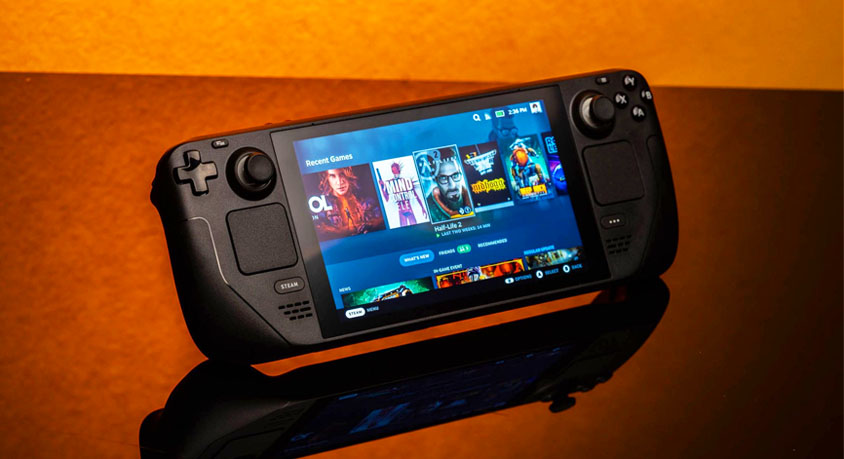
The physical design of a handheld PC is a manifesto of intent. A device like the ROG Ally or Steam Deck is unapologetically a controller first. It features proper analog sticks with full travel, tactile face buttons, triggers, and programmable rear paddles. Its form factor is wider, thicker, and heavier than any phone, because it houses active cooling fans, a larger battery, and a chipset designed for sustained performance, not bursts. It feels substantial, even bulky, in a way a phone never would. This is the first trade-off laid bare: you sacrifice the pocketable sleekness of a phone for an ergonomic grip and control surfaces built for hour-long sessions. A phone with a clip-on controller feels like a makeshift solution; a handheld PC feels purpose-built.
Performance is where the divergence becomes a chasm. The latest handheld PCs are equipped with custom AMD APUs featuring Zen CPU cores and RDNA GPU cores. The ROG Ally, for instance, uses a chip capable of roughly 8-10 TFLOPS of graphics performance. Compare this to the most powerful smartphone GPU, like the one in the latest Snapdragon, which might reach 2-3 TFLOPS. This isn't a slight difference; it's a generational gap. The practical translation is profound. On a handheld PC, you are not playing Genshin Impact at 60fps. You are playing Elden Ring, Cyberpunk 2077, or Baldur's Gate 3. You can access your entire Steam, Epic, or Xbox Game Pass library natively. The experience is running a scaled-down but visually rich PC version of the game, with settings you can tweak for a balance of fidelity and frame rate. A flagship phone is running a mobile port, often with simplified textures, geometry, and mechanics, designed to run on a thermal-throttling device without physical controls.
The experience of playing a deep, immersive game like Red Dead Redemption 2 on a commute or in bed is transformative. The handheld PC provides a self-contained universe of high-end gaming. Battery life under such load is its constraint, typically offering 1.5 to 2.5 hours for the most demanding titles, but stretching to 5-6 hours for indie or older games. It is a device for a dedicated gaming session, not for sporadic 5-minute diversions. The phone, conversely, excels at those short bursts: a round of Marvel Snap, a quick CoD Mobile match. Its gaming is interwoven with messaging and social media, a source of its distraction.
This defines the user for each device with perfect clarity. The handheld gaming PC is for the dedicated gamer whose free time is spent wanting to progress in deep, narrative-driven or complex competitive PC titles. It is for the commuter, the traveler, or the parent who wants AAA gaming away from a dedicated desk setup. It is a complementary device to a gaming desktop or console, offering true continuity of your existing library.
The flagship gaming phone is for a different person: the hyper-competitive mobile esports player who needs every frame in PUBG Mobile, or the user whose gaming is purely casual and must happen on the device already in their pocket. It is a device for which gaming is a major, but not exclusive, function.
Therefore, the financial logic becomes clear. Spending $1,500 on a phone for gaming is an inefficient allocation of capital if deep, immersive gaming is your goal. For $600-$800, a handheld PC delivers a vastly superior, more flexible, and more serious gaming experience for that specific purpose. Your $700 phone for calls, messages, and casual games remains perfectly adequate.
The argument isn't that handheld PCs are better at everything. They are worse at being phones, obviously. The argument is that the pursuit of high-end gaming on a smartphone is a category error, an attempt to force a square peg (AAA game design) into a round hole (a thermally constrained, touch-screen-only communication device). The handheld PC corrects this error by being the round peg for the round hole. You buy it not to replace your phone, but to liberate it—and more importantly, to liberate your gaming from the compromises inherent to the mobile platform. Stop trying to make your phone a serious gaming machine. Buy the tool that already is.
Disclaimer: Mention of any brand or trademark is for identification only and does not imply partnership or endorsement