The Nürburgring is an unforgiving judge. For decades, its verdict has been clear: German engineering, particularly from BMW's M division, sets the standard for sports sedan dynamics. American attempts at this formula were often dismissed as straight-line brutes, cars that could impress at a drag strip but floundered when the road introduced corners. Then, something unexpected happened. Cadillac, a brand synonymous with land yachts and suburban luxury, began posting lap times that made BMW engineers take notice. The Blackwing series, particularly the CT4-V and CT5-V, arrived not as pretenders to the throne, but as legitimate challengers. This is the story of how Detroit finally built a car that doesn't just match the Germans on a track—it beats them at their own game.
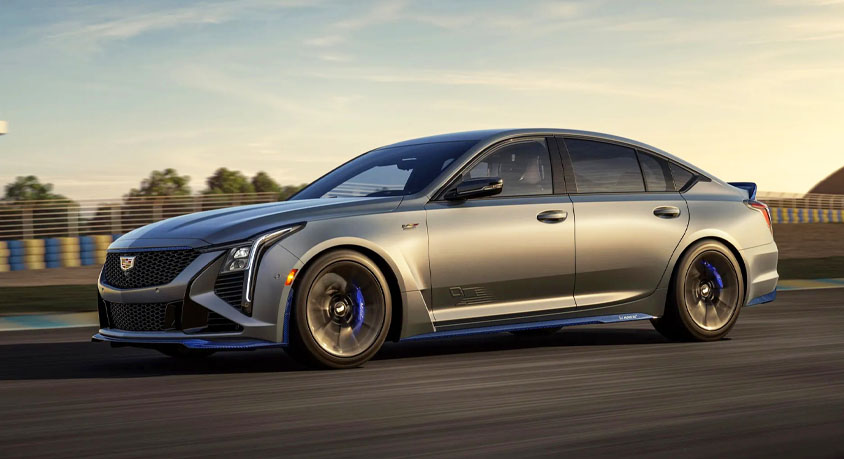
The CT4-V Blackwing is the smaller, more focused weapon in this arsenal. Its 3.6-liter twin-turbo V6 produces 472 horsepower, a figure that trails the top-tier BMW M3 Competition. But horsepower is only one variable in a complex equation. The Blackwing's chassis tuning is where the real magic lives. The magnetic ride control, calibrated by engineers who clearly spent thousands of hours on the Nürburgring and Virginia International Raceway, delivers a duality that feels almost impossible. In Tour mode, the car soaks up highway imperfections with a suppleness that wouldn't embarrass a luxury sedan. Switch to Track mode, and the suspension tightens into a taut, responsive platform that communicates every nuance of the asphalt through the seat of your pants. The steering, hydraulically assisted in the CT4-V, is a revelation in an era of numb electric racks, delivering a weighty, communicative feel that the BMW's electric steering cannot replicate.
The manual transmission is the Blackwing's secret weapon and its boldest statement. In a market where BMW has made the manual an afterthought, available only on lesser models and paired with diminishing engagement, Cadillac offers a six-speed unit engineered by Tremec that feels like it was forged for track duty. The shifter throws are short and precise, the clutch take-up is linear and intuitive, and the rev-matching feature, when engaged, executes downshifts with a perfection that embarrasses even experienced drivers. Switch it off, and you're left with a pure, analog connection to the powertrain, a requirement to heel-toe like the old days. This is not a car that insulates you from the driving experience; it demands your participation. The trade-off is a cabin that, while vastly improved, still features some hard plastics and switchgear that remind you this is a General Motors product, not a Bavarian masterpiece.
The larger CT5-V Blackwing takes a different approach to performance. Its supercharged 6.2-liter V8, shared with the Corvette, produces 668 horsepower and 659 lb-ft of torque. This is American excess weaponized for cornering. The car is massive, yet it dances. The magnetic ride control performs miracles, controlling body motion that physics says should be uncontrollable. The carbon ceramic brakes, optional and expensive, provide fade-free stopping power lap after lap. The steering, while slightly less communicative than the CT4-V's hydraulic setup, still delivers confidence and precision. The interior, shared with the less exotic Cadillac lineup, offers comfort and luxury but lacks the bespoke, driver-focused cockpit of a BMW M5. The infotainment system, while responsive, can be distracting to navigate on track.
The comparison to BMW is inevitable and instructive. The M3 and M4 are brilliant machines, refined over decades of development. Their engines are powerful, their chassis are capable, and their technology is cutting-edge. But they have become, in some ways, victims of their own success. The M3's steering, while accurate, feels artificial. The engine, while potent, sounds synthesized through the speakers. The optional all-wheel drive, while devastatingly fast, dilutes the purity of the rear-drive experience. The Cadillacs, by contrast, feel like they were engineered by enthusiasts for enthusiasts, with a singular focus on the connection between driver and machine. They are less refined, more raw, and ultimately more rewarding to drive at the limit.
The Blackwing's weaknesses are real and worth noting. The interior technology lags behind the Germans; the heads-up display is less comprehensive, the digital instrument cluster less customizable. The back seats, particularly in the CT4-V, are cramped, suitable only for children or small adults on short trips. The fuel economy is predictably abysmal, especially when driven with enthusiasm. The manual transmission, while glorious, exacts a fuel economy penalty that some buyers may find unacceptable. And the Cadillac badge, while respected, still lacks the prestige cachet of the blue-and-white roundel in certain social circles.
Yet, these compromises are part of the Blackwing's character. This is not a car designed by focus groups and marketing committees. It is a car designed by engineers who love driving, who understand that the best sports sedans are not the ones with the fastest lap times on paper, but the ones that make the driver feel like a hero. The Blackwing rewards skill, punishes mistakes, and communicates with an honesty that is increasingly rare. It is a reminder that the human element still matters, that a manual transmission and a naturally communicative chassis can deliver an experience that no amount of electric torque or autonomous technology can replicate.
In the end, the Cadillac Blackwing series is not just a competitor to the BMW M3; it is a philosophical counterargument. It proves that American engineers can build a world-class sports sedan, that Detroit can compete on handling as well as horsepower. More importantly, it proves that there is still a market for purity, for engagement, for the simple, irreplaceable joy of driving a well-sorted machine with a manual transmission and a V8 engine. The Germans may have the history, the prestige, and the volume. But the Blackwing has something rarer: a soul. And on a track, on the right road, that soul matters more than any spec sheet can measure.
Disclaimer: Mention of any brand or trademark is for identification only and does not imply partnership or endorsement