

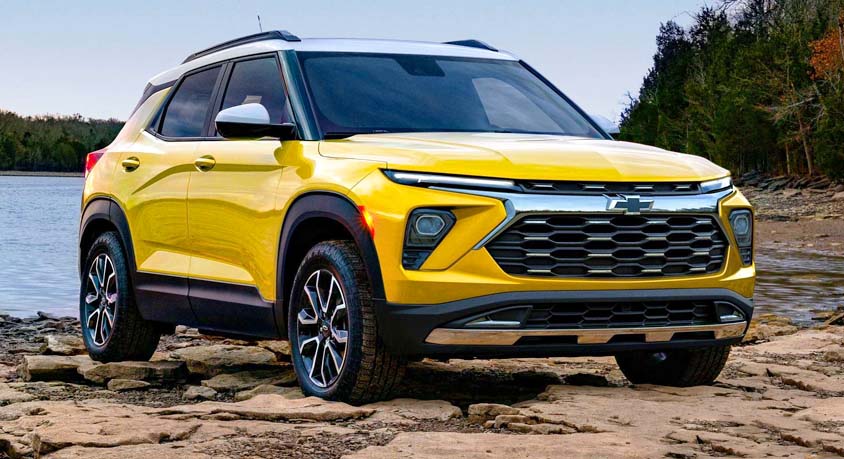
I was standing in a rain-slicked parking lot in suburban Detroit last week, watching a young couple trade in a beat-up, ten-year-old sedan for a brand-new 2026 Chevrolet Trax. From fifty feet away, in that sharp Cacti Green paint and riding on those machined 19-inch wheels, the thing looked like a baby Lamborghini Urus that had been shrunk in a hot dryer. Then I looked at the window sticker: barely twenty-four thousand dollars for a loaded trim. In a world where Ford and Toyota are trying to convince us that a $45,000 MSRP is "entry-level," Chevy is performing a high-wire act of psychological warfare. They’ve built a car that looks like a million bucks but costs less than a used Honda Civic with eighty thousand miles on the clock. As someone who has spent two decades tearing through the marketing fluff of the Big Three, I had to know exactly where the accountants hid the bodies to make this price point happen.
The old Trax was a miserable, upright lump of a car that felt like driving an oversized toaster. This new generation is a total pivot; it’s long, low, and wide, successfully mimicking the "coupe-SUV" silhouette that people usually pay a Mercedes-Benz premium for. It targets the American college grad buried in student loans and the Southeast Asian family navigating cramped urban streets with a desperate need for "face." But the moment you grab the door handle, the illusion starts to crack. It’s a standard, chunky pull-handle—thankfully not one of those motorized, flush-mounted electronic nightmares found on high-end EVs that freeze shut the moment a Michigan winter arrives. I despise those over-engineered door handles; they are a solution to a problem that didn't exist, and Chevy was smart enough (or cheap enough) to avoid them here.
Once you’re inside, the "tactile deception" is in full swing. The steering wheel in the RS trim feels surprisingly substantial, like the thick, confident grip of a fresh Louisville Slugger. But as soon as your hand wanders six inches away from the primary touchpoints, you’re greeted by the cold, hard reality of cost-cutting. The door panels are made of a polymer so rigid and unyielding that it feels like it was recycled from industrial-grade Five-Gallon buckets. There is no soft-touch material to be found on the dashboard, and the "piano black" plastic around the vents is a fingerprint magnet that will look like a crime scene within three days of ownership. Chevy didn't spend a dime on luxury materials; they spent every cent on the dual-screen digital cockpit because they know the modern buyer cares more about a crisp TikTok-ready display than the density of the foam in the door armrests.
Under the hood, the mechanical reality is even more polarizing. You’ve got a 1.2-liter three-cylinder engine that sounds like a very angry sewing machine when you really pin the throttle to merge onto a busy interstate. It doesn't have the "deep burble" of a classic American V8 or even the smooth "hum" of a Toyota four-cylinder; instead, it emits a gravelly, high-frequency "thrum" that vibrates slightly through the floorboards. It’s a tiny heart for a relatively large body, and while it’s punchy enough for a quick run to Home Depot to grab a few bags of mulch, it feels winded when you’ve got four adults on board and an uphill grade.
Compared to the Toyota Corolla Cross, the Trax feels much more alive behind the wheel. The Toyota is a depressingly competent appliance—it will outlast the heat death of the universe, but driving it feels like operating a dishwasher. The Chevy has a quicker steering rack and a chassis that actually wants to play. However, the Toyota offers All-Wheel Drive, a glaring omission on the Trax. Chevy is betting that most city dwellers in Jakarta or Chicago don't actually need AWD, and they’d rather save the two thousand dollars and several hundred pounds of weight. It’s a calculated risk that keeps the price low, but it leaves you stranded if you actually live somewhere with a real winter.
I’ve always said that you can tell where a company stopped caring by looking at the rear suspension. The Trax uses a basic torsion beam setup. On smooth city streets, it’s perfectly fine, but hit a mid-corner bump while you're rushing to pick the kids up from soccer practice, and the rear end skips and shudders like a nervous horse. It lacks the sophisticated, dampened poise of a Mazda CX-30. The Mazda feels like a precision tool designed by engineers who love the craft; the Trax feels like a clever assembly of "good enough" parts designed by accountants who love a profit margin.
But here is the hard truth: for the person trying to survive 2026 inflation, none of that matters. This car is a lifeline. It offers a full factory warranty, modern safety tech, and a "cool factor" that completely masks its budget-basement origins. It’s a masterclass in prioritized engineering. Chevy knew they couldn't give you a world-class engine and a premium interior for twenty grand, so they gave you the two things you can actually see and feel: a sexy exterior and a great set of screens. It’s a secret weapon in the war for the middle-class wallet, and as long as you don't expect it to behave like a Cadillac when the road gets rough, it might be the smartest purchase you can make this year. Just don't go poking at the plastics too hard—you might remind yourself how much you actually paid for it.
Disclaimer: Mention of any brand or trademark is for identification only and does not imply partnership or endorsement