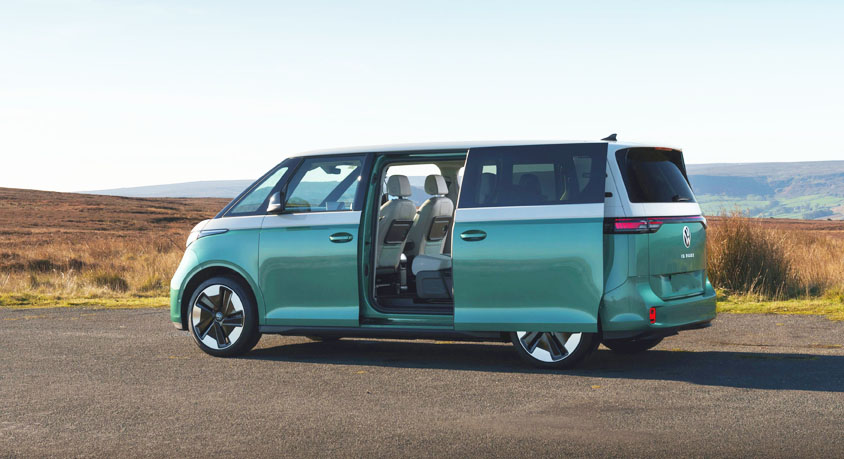
The cultural valence of a vehicle is often defined at the gas pump. For decades, the minivan driver—overwhelmingly coded as a ‘soccer mom’—occupied a specific social coordinate there: invisible, efficient, engaged in a purely utilitarian mission. The vehicle was a tool, a rolling annex of the home, a symbol of a life stage defined by sacrifice over style. Then, the Volkswagen ID. Buzz pulls into the next stall, its two-tone paint glowing under the fluorescents, its friendly, pixelated LED light bar offering a digital wink. Suddenly, the act of refueling (or rather, recharging) becomes a public performance. Teenagers point, a fellow driver gives an approving nod, and the minivan is no longer a social cloak of invisibility but a conversation piece. This is the precise moment the algorithm of family transportation was rewritten, not by adding more horsepower, but by adding cultural memory and intent.
The ID. Buzz’s power stems from its deliberate, almost mischievous, recombination of signals. It leverages the potent, pre-approved nostalgia of the original VW Microbus—a symbol of 60s counterculture and carefree adventure—but executes it with the precision of a modern software update. The shape screams “classic,” yet the surfaces are devoid of ornament, smoothed by wind tunnels for a drag coefficient of 0.29. It feels less like a retro remake and more like a memory that has been fact-checked and optimized by an AI trained on both Instagram aesthetics and crash-test data. It offers the emotional shorthand of a beloved icon with the practical credentials of a zero-tailpipe-emission, all-wheel-drive people-mover that can seat seven. It doesn’t ask to be loved for what it carries; it demands to be admired for what it is.
Driving the Buzz reveals its core proposition: the decoupling of practicality from penalty. The skateboard EV platform creates a flat floor, yielding an interior volume that shames many traditional SUVs. The sliding doors open with a quiet electric whirr to reveal a cabin that is airy, minimalist, and bathed in light from a standard panoramic roof. Yet, the driving experience is where the old “bus” stereotype is atomized. The instant, silent torque from the rear-mounted motor (or dual motors in the AWD version) delivers a 0-60 mph time in the brisk 7-second range, making freeway merges effortless. The center of gravity, locked low in the battery pack, grants it surprising agility in city traffic, a handling characteristic utterly alien to the top-heavy, underpowered minivans of yore. The utility is no longer a burden on the driving experience; it is its foundation.
This technological repackaging allows it to perform a fascinating social sleight of hand. For Gen Z and younger millennials, the original Bus is a grandfather’s story, a filtered image from music festival history. The ID. Buzz connects to that inherited coolness without the baggage of mechanical unreliability. It becomes a blank, friendly canvas. Its vast, configurable interior and 12-volt power outlets make it the ultimate gear-hauler for a weekend camping trip or a mobile studio for content creators. The “soccer mom” functional need is satisfied, but the vehicle’s identity is no longer defined by it. It can just as easily be the vehicle for a surf trip, a cross-country art project, or a group of friends heading to a festival—the very same activities its ancestor was known for, now enabled by 21st-century engineering.
However, the transition from concept to daily reality introduces friction that the sunny marketing visuals omit. The pricing, starting well over $45,000 and easily cresting $60,000, places it firmly in premium territory, a stark contrast to the accessible ethos of the original. The infotainment system, a touchscreen-heavy interface shared with other VW ID. models, can be frustratingly laggy and layered, requiring multiple taps to perform simple climate adjustments—a genuine annoyance when you’re trying to manage a car full of passengers. While range is adequate (an EPA-estimated 260-280 miles), the reality of charging a large vehicle with a big battery on a road trip requires more planning than fueling a gas-powered Sienna, introducing a logistical variable the carefree “bus” image tries to suppress.
Ultimately, the ID. Buzz’s success lies in solving a cultural equation, not just an engineering one. It demonstrated that a vehicle optimized for family utility did not have to be aesthetically or experientially bland. It proved that efficiency—of space, of energy—could be framed as a form of intelligence and even coolness. It didn’t make the minivan cool; it made a new category that absorbed the minivan’s function while rejecting its social baggage. The vehicle becomes a statement that one can be a responsible parent, an environmental citizen, and a culturally aware individual simultaneously. It swaps the cloak of invisibility for a highly visible, deliberate badge of thoughtful, optimistic modernity. The “buzz” it generates is the sound of a long-held assumption—that family life necessitates boring cars—finally short-circuiting.
Disclaimer: Mention of any brand or trademark is for identification only and does not imply partnership or endorsement