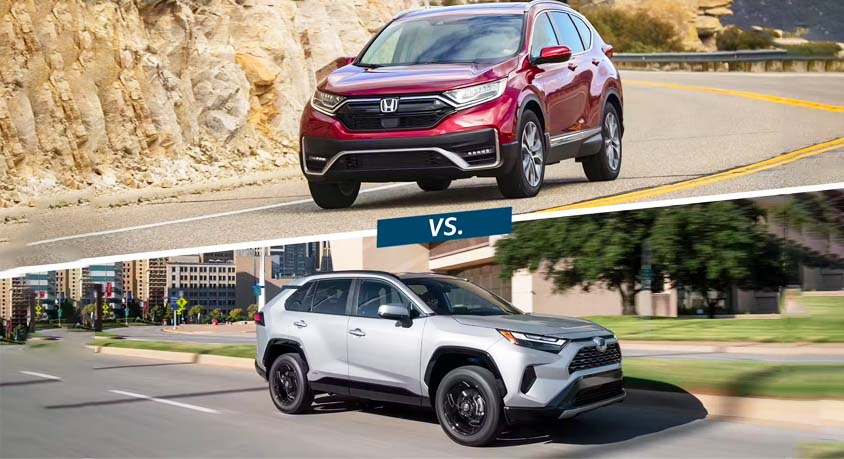
You stand in the dealership parking lot, keys to two of America's best-selling vehicles in your pocket, and you realize the choice is paralyzing. Both the Toyota RAV4 Hybrid and the Honda CR-V Hybrid have dominated sales charts for years, both offer exceptional fuel economy, both provide spacious interiors and strong resale value. On paper, they are nearly identical. But the paper does not capture the fundamental philosophical divide that separates them. One prioritizes mechanical serenity and long-term predictability above all else. The other delivers a driving experience that engages and rewards. The difference is not in the specs; it is in the soul, and understanding it is the key to choosing the right partner for the next decade of your life.
The Toyota RAV4 Hybrid is a monument to engineering conservatism. Its hybrid system, refined over two decades, pairs a 2.5-liter four-cylinder engine with three electric motors, sending power to all four wheels through a planetary gearset that Toyota calls e-CVT. This system has no belts, no clutches, no conventional transmission at all. It is essentially a continuously variable transmission, but one that uses gears rather than belts, giving it a durability that conventional CVTs cannot match. The result is a powertrain that feels seamless, almost invisible in its operation. The RAV4 accelerates smoothly, without the droning that plagues many CVTs, and the transition between electric and gas power is imperceptible. The EPA rating of 40 MPG combined is not just a number; it is a promise that you will visit gas stations half as often as your neighbors.
The RAV4's compromises are the price of its focus. The driving experience is competent but uninspired. The steering is light to the point of numbness, the chassis leans in corners, and the overall feel is one of isolation rather than engagement. The interior, while functional, is built from materials that prioritize durability over delight, with hard plastics and switchgear that lacks the damped precision of more expensive vehicles. The infotainment screen, while larger in recent years, runs software that can feel laggy, and the touchpad interface in some trims is more frustrating than intuitive. The RAV4 asks you to accept that a car is a tool, not a toy, and that reliability matters more than excitement. For millions of buyers, that is precisely the right trade.
The Honda CR-V Hybrid approaches the compact SUV equation from a different angle. Its hybrid system pairs a 2.0-liter four-cylinder with two electric motors, but the architecture is fundamentally different from Toyota's. In most driving conditions, the gasoline engine acts as a generator, sending power to the electric motor that drives the wheels. Only at highway speeds does a lock-up clutch engage, connecting the engine directly to the wheels for efficiency. This gives the CR-V a driving character that feels more electric than the RAV4, with instant torque off the line and a responsiveness that makes it feel quicker than its 8-second 0-60 time suggests. The steering is weightier, the chassis feels more planted, and the overall experience is one of engagement rather than isolation.
The CR-V's trade-offs are equally significant. The powertrain, while responsive, can be noisy under hard acceleration, with the engine droning as it generates electricity. The fuel economy, while excellent at 38 MPG combined, trails the RAV4 by a small but real margin. The interior, while more modern in design, still features hard plastics in lower areas, and the infotainment system, while responsive, has a learning curve. The rear seat, while spacious, lacks the RAV4's available comfort features. And the long-term reliability of Honda's hybrid system, while good, has not yet achieved the legendary status of Toyota's decades-old design. The CR-V asks you to accept that a car can be both practical and engaging, that efficiency need not come at the expense of enjoyment.
The interior spaces of these two vehicles reveal their priorities. In the RAV4, the cabin is a study in functional minimalism. The controls are large and easy to operate with gloves, the sightlines are excellent, and the cargo area, with its available 120-volt outlet and adjustable floor, is designed for people who actually use their SUV for truck-like tasks. The second row offers generous legroom, and the seats fold flat with a simple mechanism. In the CR-V, the cabin feels more premium, with soft-touch surfaces where they matter and a design that flows rather than boxes. The Honda's Magic Seats, which fold up to accommodate tall items, add a layer of versatility that the RAV4 cannot match. The cargo area is slightly larger, and the loading floor is lower, making it easier to load heavy items.
On the road, the differences become visceral. In the RAV4, you relax. The miles pass smoothly, the fatigue never accumulates, and you arrive at your destination feeling as fresh as when you left. It is a vehicle designed for the long haul, for the cross-country road trip, for the daily commute that you want to forget. In the CR-V, you engage. The steering communicates the road's texture, the chassis responds to your inputs, and the powertrain rewards enthusiasm. It is a vehicle designed for the driver who still enjoys the act of driving, who sees the commute as an opportunity rather than a chore. Neither is wrong, but they serve different masters.
The ownership experience reinforces these philosophical differences. Toyota has built its reputation on reliability that approaches the absolute, and the RAV4 Hybrid is the exemplar of that ethos. Routine maintenance, performed on schedule, is all that is required to keep it running for 200,000 miles and beyond. Resale value remains exceptionally strong, depreciation shallow. Honda's reputation, while excellent, is slightly less bulletproof, and the more complex hybrid system may require attention earlier. The dealership experience varies, and resale value, while strong, trails the Toyota by a small margin. Over five years, the total cost of ownership favors the RAV4, but the difference is not dramatic.
If you prioritize long-term predictability, maximum fuel economy, and the absolute lowest stress ownership, the RAV4 Hybrid is the rational choice. It will serve you faithfully for years, asking nothing in return. If you value driving engagement, if you want your SUV to feel alive rather than numb, if you're willing to accept slightly lower efficiency for a more rewarding experience, the CR-V Hybrid is the emotional choice. It will make you smile on your morning commute, even as it sips fuel. Both will serve you well. The question is not which is better, but which is better for you.
Disclaimer: Mention of any brand or trademark is for identification only and does not imply partnership or endorsement