


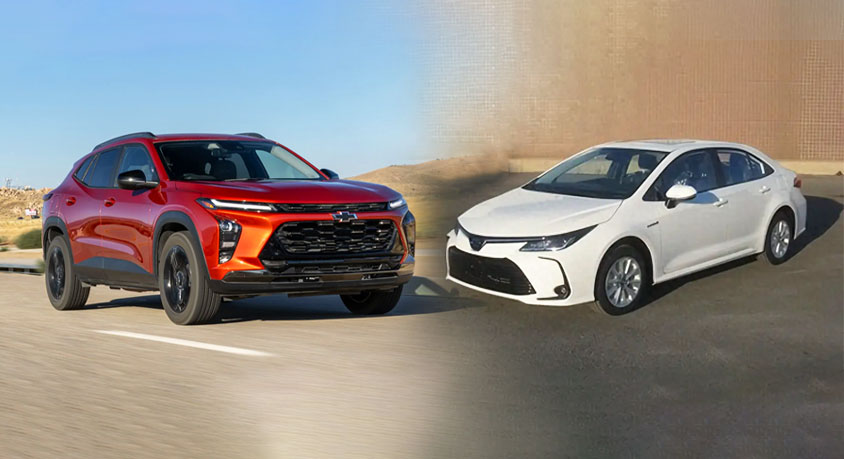
You have $25,000 to spend on a new car, and suddenly every choice feels like a compromise. The SUV you want is just out of reach, priced thousands higher. The sedan you can afford feels like a step backward, a concession to practicality rather than a statement of style. This is the classic dilemma of the budget-conscious buyer, and in 2026, it has two compelling answers. The Chevrolet Trax offers the high seating position and SUV styling that Americans crave, at a price that undercuts the competition. The Toyota Corolla offers the legendary reliability and resale value that financial advisors recommend, wrapped in a package that has improved dramatically in recent years. The choice between them is not just about transportation; it is about values, priorities, and how you define value.
The Chevrolet Trax is the surprise hit of the budget segment. Redesigned for 2024, it has grown into a genuinely competitive subcompact SUV, with styling that mimics its larger siblings and a price that starts around $22,000. The 1.2-liter turbocharged three-cylinder engine produces 137 horsepower, adequate for city driving and highway merging, if not exhilarating. The interior is spacious for the class, with rear seats that accommodate adults and a cargo area that swallows strollers and luggage with ease. The tech is modern, with an 8-inch touchscreen, wireless Apple CarPlay and Android Auto, and a suite of available driver assists. The Trax asks you to believe that you can have SUV practicality at a sedan price, and for many buyers, that is a compelling argument.
The Trax's compromises are the price of its value. The three-cylinder engine, while adequate, is coarse under acceleration, transmitting a vibration through the cabin that four-cylinder rivals avoid. The continuously variable transmission drones during hard throttle, a constant reminder of the car's budget origins. The interior, while spacious, is built from hard plastics that will scratch and scuff over time. The fuel economy, at 28 MPG combined, trails the Corolla significantly. And the depreciation, while not catastrophic, will be steeper than the Toyota's. The Trax is a vehicle for the present, for the buyer who wants maximum space and style for their money today, and is willing to accept the long-term costs.
The Toyota Corolla is the rationalist's choice. A 2026 model, with its 2.0-liter four-cylinder engine producing 169 horsepower, starts around $23,000. The engine is smooth, refined, and willing, providing adequate power without the coarseness of the Trax's three-cylinder. The continuously variable transmission, while still a CVT, is tuned to mimic traditional shifts, reducing the droning that plagues lesser designs. The interior, while not luxurious, is built from materials that will last, with switchgear that feels the same at 100,000 miles as it did at zero. The fuel economy, at 34 MPG combined, means fewer stops and more money in your pocket. The safety suite, Toyota Safety Sense 3.0, is comprehensive and standard, providing features that were optional on luxury cars a decade ago.
The Corolla's compromises are the inverse of the Trax's. The rear seat, while adequate for children, is tight for adults. The cargo area, at 13 cubic feet, is smaller than the Trax's, limiting its utility for hauling. The styling, while improved, is conservative, lacking the visual drama of the Chevy. The driving experience, while competent, is not engaging, prioritizing efficiency over enjoyment. The Corolla is a vehicle for the future, for the buyer who prioritizes long-term value over immediate gratification, who is willing to accept a smaller, less stylish car today for a more valuable asset tomorrow.
The space comparison reveals the trade-offs. The Trax's tall roof and upright seating create a sense of openness that the Corolla cannot match. Loading a child into a car seat is easier, because you don't have to bend as far. The cargo area swallows a full-size stroller with room to spare. The Corolla, by contrast, requires more contortion to load children and more Tetris-like packing for gear. For families, or for those who frequently carry bulky items, the Trax's space is a genuine advantage. For singles or couples without children, the Corolla's space is likely adequate.
The financial math over five years is revealing. Assume a $24,000 Trax, financed over five years at 6%, with $2,000 down. The monthly payment is $425. Insurance for a new driver, or even an experienced one, is similar to the Corolla. Fuel, at 28 MPG and 12,000 miles per year, costs $1,500 annually at $3.50 per gallon. Depreciation after five years, assuming 60,000 miles, is about $10,000. Total cost: $25,500 in payments, plus $7,500 fuel, plus $7,500 insurance, minus $14,000 resale value, equals $26,500 net cost. That is $5,300 per year.
Now assume a $23,000 Corolla, financed similarly. The monthly payment is $405. Fuel, at 34 MPG and 12,000 miles per year, costs $1,235 annually. Depreciation after five years is about $8,000. Total cost: $24,300 in payments, plus $6,175 fuel, plus $7,500 insurance, minus $15,000 resale value, equals $22,975 net cost. That is $4,595 per year. The Corolla saves you nearly $4,000 over five years, money that can be invested, saved, or spent on literally anything else.
If you need the space, if you value the higher seating position, if you want the style and image of an SUV, and you are willing to accept higher long-term costs, the Chevrolet Trax is the emotional choice. It will serve you well for the first few years, and you will enjoy the experience of driving it. If you prioritize long-term value, if you want to minimize your total cost of ownership, if you plan to keep the car for many years, the Toyota Corolla is the rational choice. It will save you thousands over the life of the vehicle, and it will never surprise you with unexpected repairs. The winner, in the cold light of financial analysis, is the Corolla. But the winner, in the heart of a buyer who loves the look and feel of an SUV, might be the Trax. Choose accordingly.
Disclaimer: Mention of any brand or trademark is for identification only and does not imply partnership or endorsement