


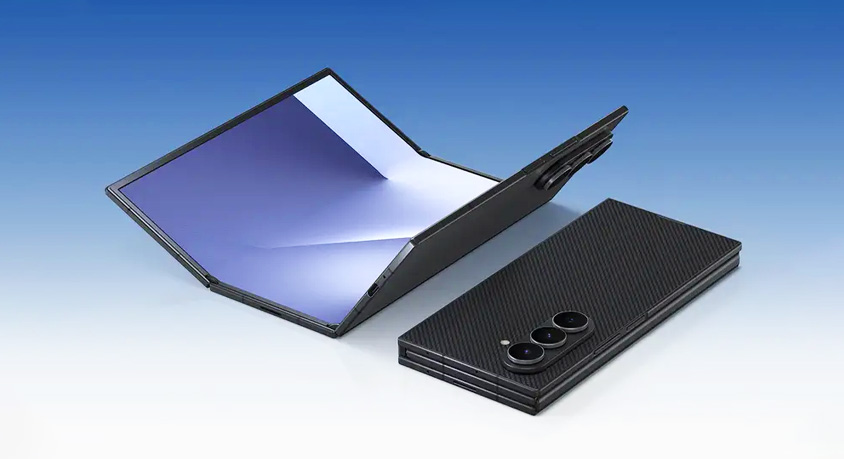
There is a moment, shortly after unboxing any foldable phone, when you handle it with the reverence reserved for ancient manuscripts or borrowed sports cars. The Samsung Galaxy Z TriFold, with its three panels and its ability to transform from a candybar-sized slab into a miniature tablet, commands this reverence in triplicate. It is a marvel of mechanical engineering, a device that seems to have bent the very laws of physics to its will. But the honeymoon phase of any relationship is defined by careful treatment. The real test begins when it becomes just another object in your life. The question I wanted to answer wasn't whether the TriFold is impressive on a launch stage, but whether it can survive the mundane, accidental brutality of a Tuesday.
Pick up the Galaxy Z TriFold and the first thing you notice is the weight. At nearly 300 grams, it has a dense, substantial heft that immediately distinguishes it from any conventional phone. Folded, it's thick, a stack of three slabs that feels secure in the hand but creates a noticeable bulge in a slim jeans pocket. Unfolded, it transforms into a 12.4-inch AMOLED screen, a canvas so expansive that holding it as a phone feels awkward, and using it as a tablet feels natural. The hinge mechanism, a dual-axis system that Samsung has refined over generations, operates with a reassuringly firm resistance. It clicks into place at full extension with a precision that suggests German engineering. For a commuter who wants a pocketable phone on the train and a tablet for watching movies at lunch, the physical promise is intoxicating.
The screen itself is vintage Samsung: vibrant, punchy, and with a 120Hz refresh rate that makes scrolling feel like gliding on ice. Brightness is ample for outdoor use, and the crease, while still visible when the screen is off and light hits it at an angle, becomes nearly invisible during normal use. For a user reviewing architectural blueprints on a construction site or a traveler following a recipe in a sunny kitchen, the expansive real estate is genuinely transformative. The stereo speakers are surprisingly full, making it a legitimate media consumption powerhouse.
But a phone is not a museum piece; it is a pocket-dweller. So, I stopped treating it like one. I dropped it into a full backpack, alongside keys, a water bottle, and the general detritus of daily life. I unfolded and folded it one-handed while walking down a busy street. I took it to the beach, letting fine sand, the nemesis of all moving parts, float in the coastal breeze. I used it in the rain.
This is where the physics of folding meets the reality of living. After a week in my bag, the main screen began to show its wear. Not cracks, but micro-indentations, tiny divots in the ultra-thin glass where a rogue key had pressed against it. The screen protector, which is not user-replaceable, started to lift slightly at the two main fold creases, creating a faint bubble that catches light and distracts during dark-mode use. The hinge, after countless folds, developed the faintest granular sensation, a subtle loss of that initial buttery smoothness. It still worked perfectly, but the mechanical perfection had been tainted by the real world.
The performance, to be clear, remains untouched. The Snapdragon 8 Gen 5 chip inside handles anything you throw at it. Splitting the massive screen into three separate app windows is a productivity dream. Imagine having a video call on one panel, research notes on another, and an email draft on the third. For a stock trader monitoring multiple charts or a student writing a paper while referencing sources, this is a level of multitasking that makes a traditional phone feel like a toy. Battery life, with a dual-cell setup, comfortably lasts a full day of mixed use, though heavy video streaming on the unfolded screen will drain it by evening.
The camera system, a triple-lens array, takes excellent photos, benefiting from the same computational photography that powers the Galaxy S series. But the act of taking a photo reveals another durability trade-off. To use the main camera, you have to be comfortable holding a thick, heavy slab, or you unfold the device and use the cover screen as a viewfinder, which feels precarious. The best camera on a TriFold is the one you use when you forget it's fragile and just shoot.
This brings us to the central tension of the device. It is an object of two worlds. In its unfolded state, it is a window into a new kind of mobile computing. In its folded state, it is a reminder of how much complexity we are asking to live in our pockets. The main screen's vulnerability to pressure points means you are constantly aware of it. You position it carefully in your bag. You wipe it obsessively. You unfold it with a deliberate two-handed motion. The freedom of the large screen comes with the constant, low-level anxiety of the responsible owner.
Who, then, is the Galaxy Z TriFold for? It is for the early adopter, the tech enthusiast for whom the novelty of the form factor outweighs the compromises. It is for the professional who genuinely needs a tablet-sized screen in their pocket and is willing to insure it, protect it, and accept that it may show its battle scars. It is not for the parent chasing toddlers, the outdoor enthusiast, or anyone for whom a phone is primarily a tool rather than a statement.
Disclaimer: Mention of any brand or trademark is for identification only and does not imply partnership or endorsement