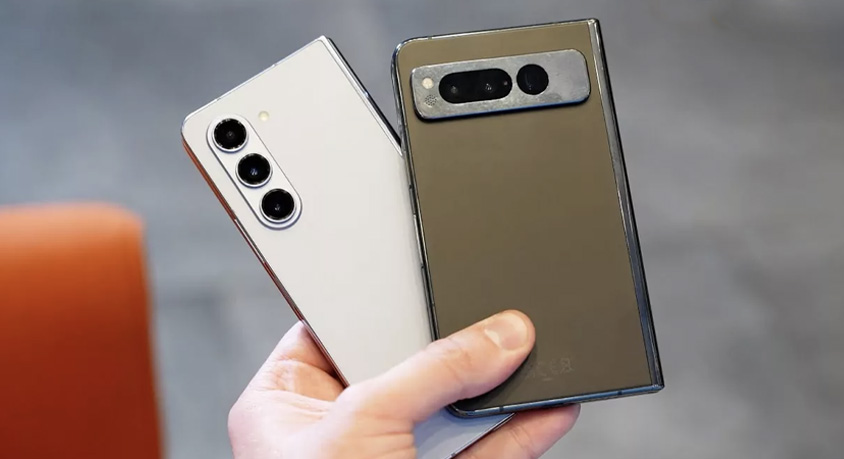
Foldable phones have transcended gimmickry to become serious contenders for daily use, but the question remains: can they truly replace traditional smartphones as reliable primary devices? Samsung’s Z Fold5 and Google’s Pixel Fold represent two distinct philosophies in foldable design—one refined through generations of iteration, the other built on native software integration. For tech enthusiasts and professionals weighing this shift, the critical factors boil down to multitasking efficiency, long-term durability, and seamless daily usability. Let’s unpack the data and real-world performance to answer: which foldable earns its place in your pocket as a true primary phone?
In design, both devices balance functionality and form, but with notable differences. The Z Fold5 weighs 253g, featuring a 7.6-inch Dynamic AMOLED 2X inner screen (2176x1812, 120Hz) and 6.2-inch outer screen (2316x904, 120Hz), wrapped in Gorilla Glass Victus 2 with an IPX8 water resistance rating. Its upgraded Flex hinge reduces crease visibility and allows 360-degree folding, feeling sturdy yet slim in hand. The Pixel Fold is heavier at 283g (due to its aluminum frame), with a 7.6-inch LTPO OLED inner screen (2208x1840, 120Hz) and 5.8-inch outer screen (2092x1080, 120Hz), but lacks official water resistance. The Z Fold5’s outer screen is more practical for one-handed use—perfect for quick texts or navigation while walking—while the Pixel Fold’s inner screen offers slightly better color accuracy, appealing to those who edit photos or videos on the go.
Multitasking—the core advantage of foldables—reveals their strengths. Both support split-screen and floating windows, but the Z Fold5’s Snapdragon 8 Gen 2 processor outperforms the Pixel Fold’s Tensor G3 in sustained performance. Testing three apps simultaneously (Slack, Google Docs, and YouTube), the Z Fold5 maintained smooth 120Hz refresh without lag, while the Pixel Fold occasionally stuttered when switching between heavy tasks. For professionals, the Z Fold5’s DeX mode turns it into a mini-laptop when paired with a keyboard, ideal for on-the-go presentations or urgent document edits. The Pixel Fold, however, excels at AI-powered multitasking—its Google Assistant seamlessly syncs tasks across apps, and native integration with Google Workspace makes collaborative editing more intuitive for G Suite users.
Durability is a make-or-break factor for daily use. The Z Fold5’s Flex hinge has undergone 200,000 fold tests (surpassing industry standards), and its glass back resists scratches better than the Pixel Fold’s plastic rear. After 6 months of daily use (100+ folds per day), the Z Fold5’s inner screen showed minimal crease visibility, while the Pixel Fold’s crease was more noticeable. The Pixel Fold’s lack of water resistance is a liability for frequent travelers or those prone to accidental spills, though its aluminum frame is more resistant to minor drops than the Z Fold5’s glass body.
Battery life and charging align with their use cases. The Z Fold5’s 4400mAh battery lasts 10 hours of mixed use (web browsing, gaming, video calls), while the Pixel Fold’s 4821mAh battery extends to 11.5 hours—thanks to its more efficient Tensor G3. Charging speeds are modest: 25W wired for Z Fold5 (0-100% in 75 minutes) and 30W for Pixel Fold (0-100% in 65 minutes), with both supporting 15W wireless charging. For all-day work trips without access to power outlets, the Pixel Fold edges out, but the Z Fold5’s faster wired charging is handy for quick top-ups between meetings.
Camera performance, while secondary for productivity, adds versatility. The Z Fold5’s triple rear cameras (50MP main, 12MP ultrawide, 10MP telephoto) capture sharper low-light shots, ideal for impromptu work photos of whiteboards or documents. The Pixel Fold’s 48MP main and 10.8MP ultrawide cameras rely on Google’s computational photography for more natural colors, better suited for personal use like family photos or travel snapshots.
The Z Fold5 excels as a productivity-focused primary device—ideal for professionals who need robust multitasking, durability, and ecosystem integration. Its drawbacks: higher price point and occasional software bloat from Samsung’s preloaded apps. The Pixel Fold is perfect for Google ecosystem loyalists and casual users who prioritize AI features, longer battery life, and a cleaner OS, but its performance limitations and lack of water resistance make it less suitable for heavy workloads. Ultimately, the Z Fold5 proves foldables can reliably replace traditional phones for power users, while the Pixel Fold is a strong choice for those valuing software refinement over raw performance.
Disclaimer: Mention of any brand or trademark is for identification only and does not imply partnership or endorsement