
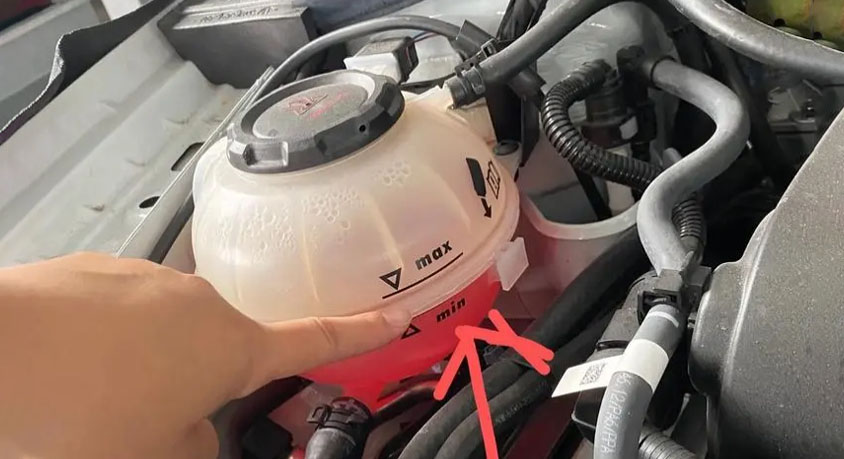
I was staring at a warped cylinder head from a five-year-old European sedan last week, and the internal water passages looked like they had been chewed on by a swarm of angry, microscopic piranhas. The owner was shell-shocked because he followed the "maintenance schedule" to the letter. He saw the "Long-Life" label on the coolant reservoir and figured he had another half-decade of worry-free driving. He was wrong, and now he’s looking at a five-thousand-dollar bill for a new top end. Car manufacturers love to tout these extended service intervals because it makes the "cost of ownership" look lower on a spreadsheet, but they aren't the ones holding the wrench when your engine starts hemorrhaging fluid in a Costco parking lot.
Most people treat engine coolant like a set-it-and-forget-it liquid, much like the windshield washer fluid. They see that vibrant pink, blue, or orange hue through the plastic tank and assume all is well. But coolant isn't just about preventing your block from cracking in a Minnesota winter; it’s a sophisticated cocktail of corrosion inhibitors designed to protect the various metals in your engine. Over time, heat cycles and electrolysis break down those chemical guards. When those inhibitors vanish, that colorful fluid undergoes a chemical heel-turn, shifting its pH level until it becomes a slow-acting acid that eats your engine from the inside out.
I have an absolute, seething disdain for the way modern "eco-friendly" engineering has forced us into these fragile cooling systems. Take the plastic water pump impellers found in many modern Volkswagens or the brittle "quick-connect" hoses on new Fords. It’s a joke. These manufacturers sacrifice mechanical honesty for shaved ounces and assembly-line speed. It’s the same corporate laziness that gave us those flush-mounted, motorized door handles that feel like flimsy plastic toys and fail the moment they see a grain of road salt. If I’m driving an old-school Toyota or a 90s-era Honda, the cooling system feels robust—like the thick, rubbery grip of a Louisville Slugger. In a new luxury crossover, the cooling system feels like it was built by a committee of accountants using recycled soda bottles.
When that coolant turns acidic, it starts an invisible war against your aluminum components. Aluminum is fantastic for weight and heat dissipation, but it’s incredibly sensitive to chemical imbalances. The acid begins "pitting" the metal, creating tiny craters in the cylinder head and the radiator core. Eventually, these pits become pinholes. You might be heading out for a weekend road trip with the family, or just hauling a load of lumber from Home Depot, and suddenly you smell that cloying, sickeningly sweet scent of burnt maple syrup. That’s the smell of your engine’s lifeblood vaporizing against a hot exhaust manifold because a "five-year" fluid decided to retire early.
Compare a modern, high-strung turbo engine to the lazy V8s of the past, and the stakes become even higher. A naturally aspirated Chevy small-block can survive a bit of neglect, but a modern, tight-tolerance engine—like those found in a Tesla-fighting EV’s thermal management system or a downsized Ford EcoBoost—will commit mechanical suicide the moment the pH balance shifts. The cooling passages are smaller, the temperatures are higher, and the tolerances are thinner than a politician's promise. If the fluid isn't pristine, the heat stays trapped, the metal expands where it shouldn't, and you get the dreaded "head gasket failure" that totals the car.
If you actually enjoy driving—if you want to feel that crisp, mechanical connection to the road without wondering if your water jacket is currently dissolving—you change your coolant every two to three years, regardless of what the "Lifetime" sticker says. "Lifetime" to a manufacturer usually just means "until the warranty expires." After that, you’re on your own.
You can actually test this yourself for about ten bucks. Buy a pack of pH test strips. Dip one in the reservoir when the engine is cold. If that strip comes back looking like a science experiment gone wrong, you’re already in the danger zone. It’s a tactile, satisfying bit of DIY maintenance that saves you from a catastrophic "thermal event" down the road. There is a specific kind of peace of mind that comes from knowing the fluid circulating through your block is actually protecting it, rather than slowly digesting it.
Don't let the marketing departments convince you that your car is a maintenance-free appliance. It’s a machine made of iron, aluminum, rubber, and chemistry. When the chemistry fails, the metal suffers. Respect the fluid, ignore the "Long-Life" lies, and flush that system before the pink stuff turns into a liquid wrecking ball.
Disclaimer: Mention of any brand or trademark is for identification only and does not imply partnership or endorsement