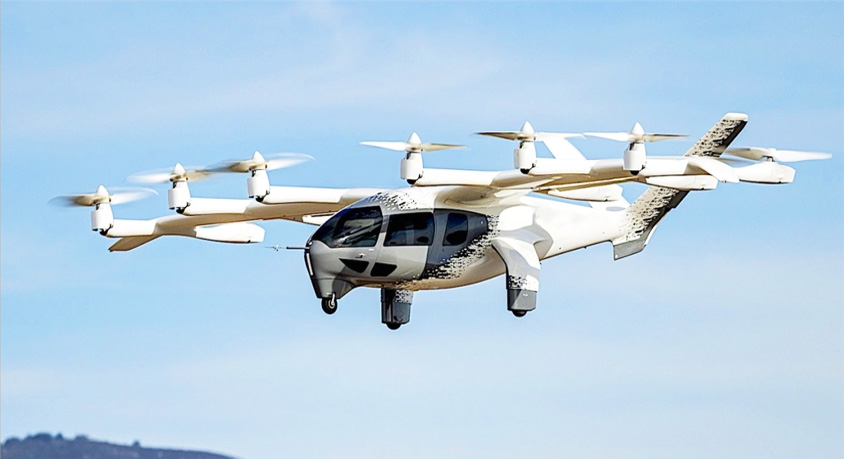
The defining sensation isn't lift-off; it's the sudden, profound irrelevance of the scene below. One moment, you're in a minimalist pod at a "Vertiport" atop a Santa Monica parking structure, the familiar, simmering rage of the 405 Freeway audible as a distant, frustrated roar. The next, after a surprisingly gentle electric whirr that builds to a resonant hum, the multi-rotor aircraft—a Joby Aviation S4—translates straight up, and the world flatten into a map. The stalled river of taillights becomes a static, pathetic diorama; your destination, an office near LAX, is now a mere 6.2 miles away, not a 90-minute sentence. This is the visceral, almost godlike promise of the 2026 urban air mobility revolution: the ability to opt out of two-dimensional geography. But as the aircraft transitions from vertical lift to wing-borne forward flight, the question shifts from "Can it work?" to "At what cost, and for whom, does this become a rational alternative to the hell we know?"
The experience inside the cabin during the 6-minute flight is a study in controlled surrealism. The noise, while significant, is a smooth, electric-bass thrum, quieter than a helicopter's mechanical thrash but more pervasive than road noise in a luxury car. You feel the vibrations through your seat, a constant physical reminder of the twelve powerful electric motors straining against gravity. The view is breathtaking and disorienting; you watch your phone's mapping app render your progress in real-time, a little icon smoothly gliding over neighborhoods you've only ever known as a labyrinth of stoplights and left-turn lanes. There is no "driving," only being conveyed. The pilot, present in this early phase, is more a systems manager than a stick-and-rudder aviator, monitoring a bank of screens. The passenger's role is reduced to that of a privileged, slightly anxious parcel.
The economic and logistical reality of this escape, however, quickly grounds the fantasy. The inaugural fare for the 12-mile hop from Santa Monica to near LAX is $185. This isn't transportation; it's a premium service with a price point that places it squarely in the realm of expense-account business travel, last-mile helicopter transfer for the ultra-wealthy, or a once-in-a-lifetime novelty. Proponents argue costs will fall with scale and automation, but the pathway to a fare competitive with an Uber Black, let alone a personal vehicle, is long and fraught with immense infrastructure investment. The true cost isn't just the ticket; it's the billions required to build a networked grid of Vertiports with sufficient capacity, security, and community acceptance to make the service genuinely convenient, not just a point-to-point novelty.
The vehicle's performance metrics are simultaneously impressive and limiting. The Joby S4 has a maximum range of about 150 miles on a charge and a cruise speed of 200 mph, making it perfect for regional hops across a metro area. However, its operational envelope is tightly constrained. It cannot fly in moderate rain, high winds, or poor visibility. The "transcendence" it offers is fair-weather only. Furthermore, every launch and landing requires a dedicated, certified Vertiport—you cannot summon it to your driveway. Your journey now has three legs: ground transport to the Vertiport, flight, then ground transport from the destination Vertiport. The time saved in the air can be easily erased by the first and last-mile ground logistics, a hurdle known in the industry as the "Vertiport problem."
This leads to the most critical friction point: public trust and regulatory inertia. The Federal Aviation Administration (FAA) has granted certification, but the pathway is new and conservative. Every component, from battery redundancy to flight software, is scrutinized with aviation's zero-failure tolerance, not automotive's more lenient standards. The safety record in this initial, tightly controlled phase is impeccable, but the specter of a single high-profile accident over a populated area could ground the entire industry for years. Convincing the public to trust an automated, multi-rotor aircraft flying over their homes and schools is a sociological challenge far greater than the engineering one. The "dare" in the headline isn't about thrill-seeking; it's about betting on the statistical perfection of a complex, automated system in an environment with no "pull over" option.
Ultimately, the inaugural eVTOL flight is less a glimpse of a ubiquitous future and more a stark delineation of a new transportation caste system. It proves the technology works with stunning effectiveness, rendering a soul-crushing commute into a brief, fascinating interlude. Yet, it does so at a cost and within an infrastructure bubble that serves the few, not the many. It is not a solution to Los Angeles's traffic; it is an elegant, expensive escape hatch for those who can afford to bypass the problem entirely. The service is a masterpiece of aerospace engineering and a triumph of venture capital, but it is not yet a revolution in mobility. The future has arrived, but it is currently docking on a private roof, accessible only by a credit card with a limit high enough to make the suffering of the 405-freeway below someone else's concern. We have learned to fly over traffic, but we have not yet learned how to make that freedom anything but a luxury good.
Disclaimer: Mention of any brand or trademark is for identification only and does not imply partnership or endorsement