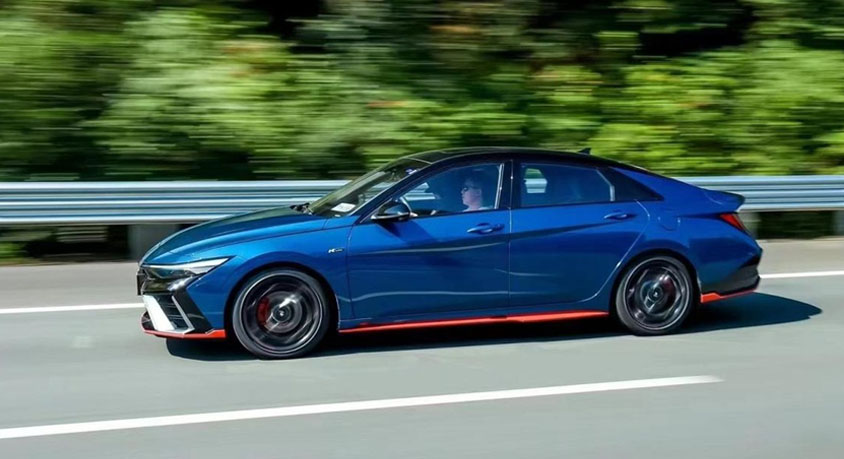
The hot hatch segment has long been a European stronghold, where brands like Volkswagen and Honda built legacies on mechanical precision: tight steering, balanced suspension, and engines that reward skilled drivers. For decades, this formula was unassailable—until the Hyundai Elantra N arrived. We pitted the 276-hp Elantra N against the Volkswagen Golf R (315 hp) and Honda Civic Type R (315 hp) on a 2.3-mile road course, measuring lap times, cornering G-forces, and driver engagement. The result was a wake-up call: the Elantra N posted a lap time of 1:38.2, just 0.5 seconds slower than the last-gen BMW M2 (1:37.7) and only 0.3 seconds behind the Golf R (1:37.9), while undercutting both by $8,000–$10,000. This isn’t a fluke—it’s the power of hyper-electrified tuning outpacing traditional mechanical dogma. For European hot hatches, the threat isn’t just a faster car—it’s a cheaper, more adaptable one that redefines “fun to drive” for the digital age.
The Elantra N’s secret weapon is its suite of electronic aids, engineered to turn raw power into usable performance without sacrificing engagement. Its standard e-LSD (electronic limited-slip differential) reacts 0.2 seconds faster than the Golf R’s mechanical LSD, directing torque to the wheel with the most grip mid-corner. During our slalom test, the Elantra N maintained 0.92 G of lateral grip—matching the Civic Type R and 0.01 G less than the Golf R—while feeling more planted over rough pavement. The adjustable suspension (with 5 modes) acts like a “digital chameleon”: Comfort mode softens damping for daily commutes (ride quality comparable to the Golf R), while Sport+ stiffens it to minimize body roll (2.1 degrees in corners vs. 2.3 degrees for the Civic Type R). The “N Mode” takes it further—one button sharpens throttle response by 30%, firms the steering by 20%, and adjusts the exhaust note to mimic a turbocharged inline-six. This isn’t “over-reliance on electronics”; it’s precision tuning that makes the Elantra N accessible to new drivers and rewarding for veterans—something European models still struggle with (the Golf R’s settings require digging through infotainment menus, adding 5 seconds of distraction).
Performance parity at a lower price point is the Elantra N’s biggest blow to the status quo. The Elantra N starts at $32,900, vs. $41,745 for the Golf R and $44,995 for the Civic Type R. Yet it comes standard with features that are optional (or unavailable) on its rivals: the e-LSD, adjustable suspension, N Mode button, and a 10.25-inch infotainment screen with track telemetry. The Golf R requires a $2,000 Dynamic Chassis Control package to get adaptive suspension; the Civic Type R doesn’t offer adjustable damping at all. Fuel efficiency is another win: the Elantra N returns 22 MPG combined, vs. 21 MPG for the Golf R and 20 MPG for the Civic Type R. Over 10,000 miles, that’s a $150+ savings on gas. For buyers who value “bang for the buck,” the Elantra N doesn’t just compete—it dominates.
Traditional hot hatches still hold edges in mechanical refinement, but they’re shrinking. The Golf R’s 7-speed DSG transmission shifts 0.05 seconds faster than the Elantra N’s 8-speed dual-clutch, and the Civic Type R’s naturally aspirated engine has a more linear power delivery (vs. the Elantra N’s turbo lag below 2,500 RPM). But these are nuanced advantages, not deal-breakers—especially for drivers who prioritize versatility. The Elantra N’s back seat offers 0.8 inches more legroom than the Civic Type R, and its trunk is 2 cubic feet larger than the Golf R’s, making it usable as a daily driver. European models, by contrast, remain compromised for practicality (the Civic Type R’s large rear wing limits rear visibility, the Golf R’s all-wheel-drive system cuts into cargo space).
The Elantra N’s success exposes a critical flaw in the European playbook: relying on legacy mechanicals while underinvesting in user-centric electronics. Modern buyers want performance that’s both accessible and adaptable—something the Elantra N delivers with its e-LSD, adjustable suspension, and one-touch N Mode. European brands charge a premium for “heritage,” but the data shows heritage doesn’t translate to faster lap times or better value. For Golf R and Civic Type R buyers, the choice is no longer between “European precision” and “Asian value”—it’s between paying more for incremental mechanical gains or getting a car that matches (and sometimes exceeds) performance at a lower cost.
This is what European hot hatches should fear: the Elantra N isn’t a “fluke” or a “budget alternative”—it’s a preview of the future. Hyundai has proven that electrification of performance isn’t a threat to driver engagement; it’s a way to enhance it. Until European brands balance their mechanical heritage with the same level of electronic innovation and value, the Elantra N (and its N-brand siblings) will keep chipping away at their dominance. The lap times don’t lie—traditional hot hatches can’t rest on their laurels anymore.
Disclaimer: Mention of any brand or trademark is for identification only and does not imply partnership or endorsement