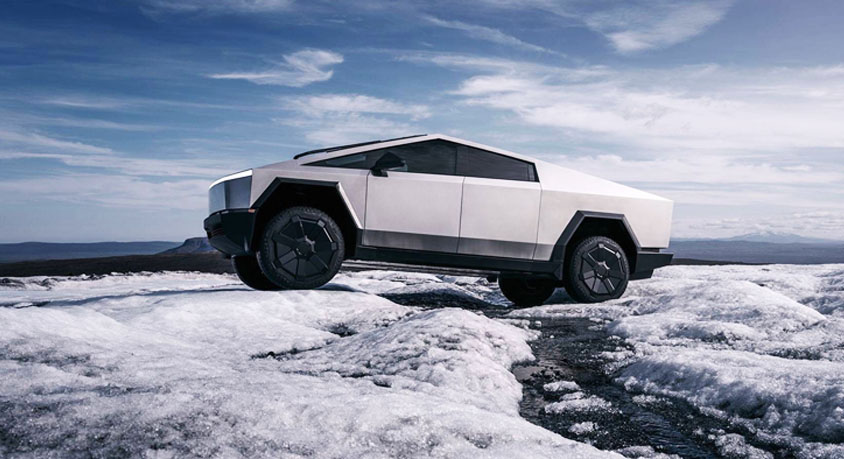
The future arrived with a muted thud in a service center parking lot in Austin, not on a gleaming stage. A 2024 Tesla Cybertruck Foundation Series, its angular stainless steel panels now dotted with a constellation of fine, reddish-brown specks along the door seams and wheel arches, sat waiting for its third major service appointment in 36 months. Its owner, a former early-adopter evangelist, scrolled through his phone gallery not of epic off-road adventures, but of dated work orders: one for a persistent half-shaft vibration, another for a failed tonneau cover motor, a third for a mysterious "front powertrain error" that left the truck inoperable for three weeks. The initial awe at its alien presence has calcified into a more complex, weary familiarity. Three years on, the Cybertruck’s story is no longer about defying physics with bulletproof steel; it’s about the relentless, mundane physics of entropy, maintenance logistics, and the true cost of owning a prototype that was sold as a production vehicle.
The exoskeletal promise of the cold-rolled stainless steel "HFS" (Hard Ultra-Stainless) has revealed its paradoxical nature. The material is incredibly resistant to dents, a fact celebrated by owners who’ve brushed against pine branches without a scratch. However, in the chemical and environmental soup of real American roads—particularly in the salt-belt states of the Midwest and Northeast—it is susceptible to surface corrosion, specifically iron oxide staining or "tea-staining." This isn't structural rust eating through a frame, but it’s a pervasive cosmetic issue Tesla did not initially warn about. The flat, uncoated panels also act as a perfect canvas for every fingerprint, water spot, and road film, turning a vehicle marketed as low-maintenance into one that demands constant detailing to look presentable. The "armor" requires its own specific, careful upkeep.
This maintenance, when required, unveils the second major friction point: the service and repair ecosystem. The Cybertruck’s radical design and low production volume have created parts scarcity and technician expertise bottlenecks. A minor fender-bender that would mean a week in a body shop for an F-150 can result in a months-long odyssey for a Cybertruck owner, waiting for specialized stainless steel panels and trained personnel. One owner in Florida reported a 14-week wait for a rear-quarter panel after a parking lot incident. The integrated structural battery pack and body-on-exoskeleton design, while innovative, turn what would be a simple repair on a traditional body-on-frame truck into a complex, costly, and time-consuming procedure. Your futuristic truck is often at the mercy of a very small, very backlogged segment of the Tesla service network.
The driving experience after three years is a tale of two realities. The performance metrics remain staggering: the instant, silent torque shove that pins passengers to their seats feels no less potent, and the low center of gravity from the massive battery pack provides shockingly competent handling for something so large. Yet, the initial polish has worn off to reveal persistent software gremlins and ergonomic frustrations. Owners report recurring issues with the steer-by-wire system’s calibration, the windshield wiper’s inadequate coverage and noise, and the sensitivity of the massive windshield to cracks from road debris—a $1,500+ replacement. The stark, minimalist interior, while easy to clean, amplifies every squeak and rattle that develops over tens of thousands of miles on rough highways, and the lack of traditional buttons for critical functions remains a point of contention, especially when the central touchscreen experiences lag or requires a reboot.
As a utilitarian pickup, the Cybertruck’s assessment is mixed. The powered tonneau cover, a headline feature, has been a notorious failure point for many early units, with motors failing and leaving the bed inaccessible. When it works, the vault-like bed and versatile 120V/240V power outlets are genuinely useful. But its overall utility is hamstrung by its form-over-function design: the sloped sides reduce practical cargo space compared to a traditional bed, and the lack of standard tiedown points in the early models was an oversight that baffled actual tradespeople. It can tow impressively, but with the same catastrophic range penalty that afflicts all electric trucks, a fact that has relegated many Cybertrucks to the role of daily commuter or statement vehicle rather than a true workhorse.
Financially, the story is one of steep, silent depreciation beyond just the hefty initial price tag. While Tesla does not publish official data, industry estimators and anecdotal resale listings suggest values have fallen more precipitously than those of a conventional full-size truck, due largely to the concerns about long-term durability, repair costs, and rapid technological iteration. The "future-proof" design now feels like a first-generation bet, with owners wondering about the cost and complexity of eventual battery repairs outside of warranty. The promise of lower operating costs is real—electricity is cheaper than gas—but it is being eroded by high insurance premiums, tire wear from the immense weight and torque, and the potential for those show-stopping repair bills.
So, what lies beneath the stainless steel shell after three years? Not a dystopian nightmare, but a sobering lesson in the gulf between revolutionary concept and daily reality. It is a vehicle of breathtaking capability and equally breathtaking compromise. It inspires curiosity and conversation everywhere it goes, but it also demands a level of owner patience, flexibility, and tolerance for uncertainty that would break a conventional truck buyer. The Cybertruck is not a failure; it is a demanding, high-maintenance experiment on wheels. It didn’t bring the apocalypse; it brought the reality check. For the owners who knew they were signing up for a beta test, the tears are of frustration, not regret. For the industry and the public watching, the real revelation is that the future of the pickup truck, if this is it, is far more complicated, expensive, and fragile than the uncompromising steel exterior was ever meant to suggest.
Disclaimer: Mention of any brand or trademark is for identification only and does not imply partnership or endorsement