



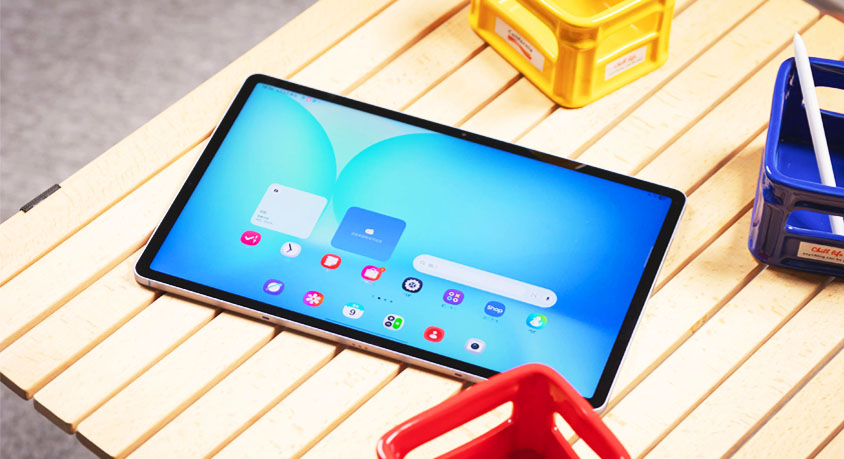
We operate under a powerful, often unchallenged assumption in consumer tech: that a higher price tag is a reliable proxy for a significantly better experience. This logic holds until you examine the actual usage patterns of the majority. For tasks like streaming video, attending online lectures, browsing the web, and light document work, the performance curve plateaus rapidly. Having tested devices like the Lenovo Tab M11 and the Samsung Galaxy Tab A9+, which retail squarely in the $250 range, I propose a different framework. Instead of asking what a premium tablet can do, ask what you actually need to do. The answer, for most, reveals a staggering overinvestment in hardware that sits idle. This is the case for the strategic underdog.
Physically, these tablets understand their assignment. The Lenovo Tab M11 features an all-metal unibody that feels solid, not cheap. The Samsung Galaxy Tab A9+ uses a polished plastic back that is lightweight and grippy. They are not the impossibly thin, all-screen marvels their $1,000 counterparts are; their bezels are noticeable, housing decent front-facing cameras for video calls. They have standard USB-C ports for charging and audio jacks—a feature often omitted on flagships. The weight and balance are comfortable for holding over long periods. This is design stripped of pretension, focused on durability and function for a classroom or a family room. The aesthetic statement is pragmatic, not prestigious.
The experience is defined by the screen and the battery, the two most critical components for media consumption. The Lenovo Tab M11 boasts an 11-inch, 1920x1200 resolution LCD with a 90Hz refresh rate. The Samsung Tab A9+ offers a similar 10.9-inch LCD at 1920x1200. These are not OLED panels with infinite contrast, but they are bright, sharp, and perfectly color-accurate enough for watching Netflix, YouTube, or reading digital textbooks. The difference between this and a premium screen is measurable on a spec sheet but marginal in a dimly lit room watching a movie. Paired with quad speakers tuned by brands like Dolby Atmos or AKG, the audio-visual experience is immersive and frankly, excellent for the price. The 7,040mAh and 7,040mAh batteries respectively are the workhorses here. In a continuous video playback test, both devices reliably exceeded 12 hours. They are devices you charge at night and use throughout the next day without a thought.
Performance is where expectations must be calibrated. Powered by mid-range chips like the MediaTek Helio G88 or Snapdragon 695, these tablets are not for gaming beyond casual titles like Among Us or Stardew Valley. They are not for editing 4K video. However, for their intended purpose, they are flawlessly adequate. Apps like Netflix, Disney+, Spotify, Chrome, and Microsoft 365 (Word, Excel, PowerPoint) launch quickly and run smoothly. Switching between a lecture on Zoom, a PDF textbook, and a notes app is seamless. The performance bottleneck for basic productivity and media simply does not exist here. The operating system, whether it’s a clean version of Android or Samsung’s One UI, is optimized to run fluidly on this hardware. There is no lag or stutter in the core user interface. The waste is not in this machine’s capability, but in paying for power you will never utilize.
The limitations are specific and important to acknowledge. The cameras are serviceable for document scanning and video calls but poor for photography. Storage is often 64GB or 128GB, expandable via microSD, which is sufficient but requires management. They will not receive OS updates for as many years as an iPad. They are not creative powerhouses.
Thus, the audience is crystal clear. This $250 tablet is the perfect, rational choice for the student who needs a device for note-taking, research, and entertainment in a dorm. It is the ideal family tablet for streaming in the kitchen or living room, durable enough for shared use. It is the superb secondary screen for recipes, control panels, or light reading. It is for anyone whose digital life revolves around consumption and communication, not creation.
You should not buy this if you are a digital artist, a musician producing tracks, or someone who needs desktop-class applications for work. But for perhaps 80% of tablet users, the premium device offers diminishing returns that are emotionally marketed, not functionally required. The $250 tablet delivers 95% of the core tablet experience for 25% of the price. The “pro” in pro devices often stands for “professional,” not “profoundly better for watching YouTube.” Stop overpaying for the horizon of potential. Buy for the reality of your use. This slate isn’t a compromise; it’s a revelation of efficiency, proving that for mainstream needs, the most intelligent engineering often happens at the budget end, where every component must justify its cost.
Disclaimer: Mention of any brand or trademark is for identification only and does not imply partnership or endorsement