

The moment you slide behind the wheel of the pre-facelift EQS, something feels subtly wrong. It's not the acceleration, which arrives in a silent, relentless wave. It's not the cabin, which dazzles with more pixels than a Times Square billboard. It's the hood ornament—or rather, the absence of one. For over a century, the three-pointed star standing proudly on the prow of an S-Class has signaled arrival, authority, and a certain old-world seriousness. The EQS, for all its technological ambition, arrived with a smooth, amorphous snout that seemed embarrassed to be a Mercedes at all. American buyers, never shy about voicing displeasure, voted with their wallets. Now, for 2026, Mercedes has performed an act of radical humility: they listened. We spent a week with the facelifted EQS, charging across the Southwest to understand whether a hood star and a fundamental rethink of the electrical architecture can restore the electric flagship to its rightful throne.
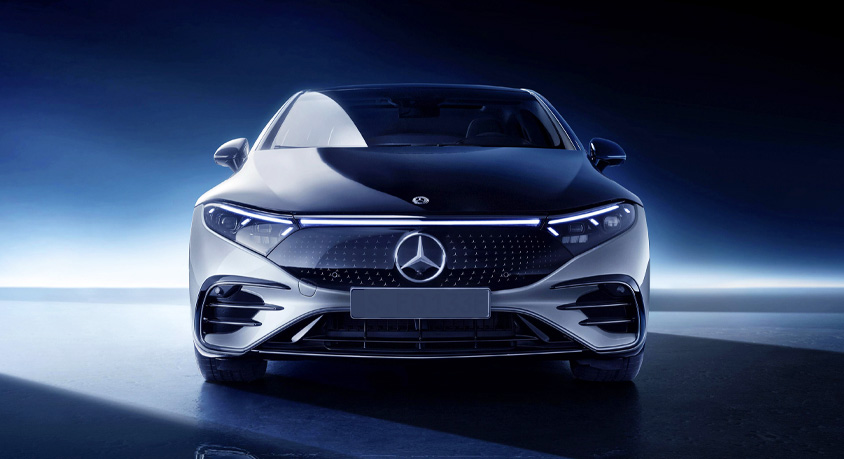
Let's start with the visual apology, because it's the most visible signal of Mercedes's strategic pivot. The 2026 EQS replaces the previous blob-like front end with a proper grille surround and, on certain trims, the return of the upright three-pointed star on the hood. The new headlights incorporate the brand's three-pointed star into the lighting signature itself, a detail that sparkles with the kind of heraldic pride the original design seemed to reject. The lower bumper has been reshaped, and while the fundamental "one-bow" silhouette remains constrained by the underlying platform, the visual messaging has shifted from anonymity to identity. It matters more than aerodynamics would suggest. When you walk up to this car in a hotel parking lot, it finally looks like the money you spent.
The real revolution, however, is invisible to the eye and far more consequential. The 2026 model migrates from a 400-volt architecture to an 800-volt system, a leap that rewrites the physics of long-distance travel. The previous 200-kilowatt charging ceiling, imposed by the amperage limits of the CCS standard at 400 volts, simply disappears. While Mercedes hasn't announced the new peak figures, the switch to silicon carbide power electronics alone should increase range by approximately 5 percent through reduced heat losses. The new eATS 2.0 drive units, developed in-house rather than sourced from Valeo, promise greater efficiency and smoother power delivery. The EPA estimates tell part of the story: the rear-drive EQS450+ now achieves 390 miles of range, while the all-wheel-drive variants deliver 367 to 371 miles depending on configuration. On our 75-mph highway loop, a 2025 model we tested earlier returned an astonishing 400 miles, suggesting the 2026 version with its electrical upgrades could push even beyond that.
The charging experience transforms the ownership proposition entirely. Park at a 350-kilowatt Electrify America station, and the new architecture should slice significant time from the previous 31-minute 10-to-80-percent charge. For the cross-country road tripper, this matters more than peak horsepower. More practically, every 2026 EQS now ships with a NACS adapter, granting access to the Tesla Supercharger network. The psychological weight of this cannot be overstated: the anxiety of planning routes around compatible chargers evaporates when 17,000 Superchargers suddenly appear on your navigation screen. Mercedes understands that range is not just a number but a feeling of freedom.
Inside, the Hyperscreen remains the visual anchor, a 56-inch glass waterfall that stretches from A-pillar to A-pillar. The system now runs on updated software with 8-core processing power and 24 gigabytes of RAM, and the response times finally match the visual ambition. The "zero-layer" interface keeps navigation perpetually foregrounded while AI learning surfaces function contextually—seat massage at the time of day you usually request it, the garage door opener when you approach home. The passenger screen remains controversially visible to the driver, but the intelligent dimming helps. The real improvement, however, is the incoming switch to MB.OS, which promises even more fluid voice interaction and 3D navigation that understands the time of day and renders buildings accordingly. For now, the system works without the frustrating lag that plagued earlier iterations.
Let's address the compromises, because they persist despite the updates. The rear seat, while offering limousine-like legroom on paper, forces passengers into an upright backrest angle that grows tiresome after an hour. The cabin, for all its digital theater, suffers from creaks and resonances that feel unworthy of a six-figure luxury sedan. The touch-sensitive steering wheel controls remain exercises in frustration, requiring glancing down to confirm inputs rather than the muscle-memory satisfaction of physical buttons. The wireless charging pad, despite the new cooling fan, still struggles to keep phones from overheating on long drives with navigation running. And the decision to offer simulated soundscapes, while harmless, seems to miss the point: buyers of $100,000 electric sedans want silence, not artificial noise.
The driving experience rewards those who prioritize refinement over engagement. The air suspension floats over expansion joints with the imperiousness of a private jet touching down, and the rear-axle steering, which turns the rear wheels up to ten degrees, makes this 207-inch leviathan maneuverable in tight parking structures. The brake pedal, reprogrammed in recent updates, now feels natural rather than artificially spongy. The acceleration, while adequate, no longer impresses in an era of Plaid-mode Teslas and Lucid Air Sapphires. The EQS450+ reaches 60 in 5.4 seconds, the 580 in 3.7—respectable figures that prioritize smoothness over brutality. Mercedes has clearly decided that electric luxury means isolating occupants from the experience of motion rather than thrilling them with it.
The market positioning grows more intriguing by the month. Mercedes has confirmed that the EQS sedan will not see a second generation; its role will eventually merge with the next-generation S-Class, which will offer both internal combustion and electric powertrains under a single, cohesive design. This means the 2026 facelift represents the final evolution of the dedicated electric flagship concept. For buyers, this creates an interesting calculus: the current car, with its updated 800-volt architecture and NACS compatibility, will remain technologically competitive for years, but the model line itself faces an uncertain long-term future. The pricing reflects this reality, with the base EQS450+ starting at approximately $104,400, slightly reduced from previous years to maintain competitiveness against the BMW i7 and Lucid Air.
Disclaimer: Mention of any brand or trademark is for identification only and does not imply partnership or endorsement