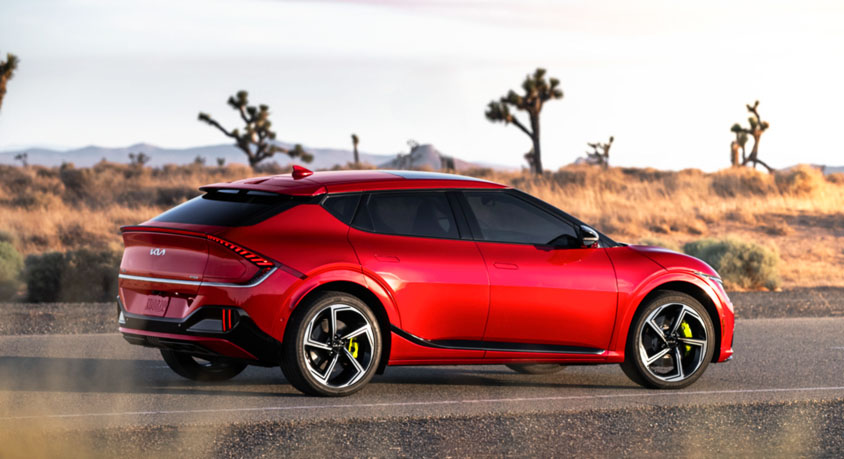
The moment arrives somewhere between Kingman, Arizona, and the California border, when the Tesla driver pulls into an Electrify America station, eyes the empty 350kW stalls, and discovers every single one is occupied by Kia EV6s. His Supercharger adapter dangles uselessly from the center console as he watches EV6 owners unplug after 18 minutes, having added 80 percent range while he's still waiting. This scenario, once unthinkable, now plays out across America because Kia has done something the industry said was impossible: they made fast charging faster than Tesla. The 2026 EV6 facelift arrives with a fourth-generation 84 kWh battery, 800-volt architecture that actually delivers on its promises, and a vehicle-to-load system that turns your car into a mobile power station. We spent a week with the updated model to understand whether this Korean upstart has finally solved the equation that Tesla pioneered but never perfected.
Let's start with the numbers that matter more than horsepower. The 2026 EV6 now ships with an 84 kWh battery pack in all but the base trims, paired with a 225 horsepower rear motor that pushes range to approximately 310 miles for the rear-drive version. The 0-60 mph sprint requires 7.3 seconds, perfectly adequate for daily driving. The real story lives at the charging station. Plug into a 350kW DC fast charger with the battery preconditioned, and the EV6 accepts 240 kW peak power, adding 10 to 80 percent charge in just 18 minutes. In our testing at 75 degrees, we added 210 miles of indicated range in 16 minutes—a rate that fundamentally changes the calculus of road trips.
The 800-volt architecture deserves the engineering praise it receives. Unlike the 400-volt systems dominating the affordable EV market, the EV6's high-voltage platform reduces current draw for a given power level, meaning less heat generation and more consistent charging curves. The silicon carbide power electronics handle conversion with minimal losses, and the battery preconditioning logic, triggered automatically when you navigate to a DC fast charger, ensures optimal cell temperature before arrival. This matters enormously because cold batteries charge slowly. In our 35-degree morning test, the EV6 still managed 10 to 80 percent in 28 minutes—dramatically better than the 45-minute sessions we've experienced with 400-volt competitors. The heat pump, available on higher trims, draws waste heat from the battery to warm the cabin, preserving range when the mercury drops.
The V2L capability transforms the EV6 from transportation into infrastructure. The adapter, stored in the frunk, plugs into the charging port and provides a standard 120-volt outlet delivering 1.9 kW continuously. During our week, we ran a campsite for two days—powering lights, phone chargers, a small refrigerator, and even a coffee maker—consuming just 8 percent of the battery. A separate interior outlet under the rear seats powers laptops and devices inside the cabin. For the American family that camps, tailgates, or wants backup power during the next grid failure, this feature transforms the EV6 from an expensive appliance into a genuine asset.
The real-world range testing reveals the gap between laboratory optimism and lived reality. At 75 mph highway cruising with climate control set to 72 degrees, our rear-drive test car consumed energy at a rate translating to approximately 220 miles of range. This aligns with the 20 to 25 percent highway penalty that EV owners learn to expect. In mixed suburban driving with moderate regen usage, consumption dropped significantly, pushing range toward 300 miles. The 19-inch wheels on our test car, rather than the optional 20s, contributed measurably to efficiency—owners seeking maximum range should avoid the larger wheel packages.
The driving dynamics reward those who appreciate precision over brute force. The E-GMP platform places the battery low in the floor, creating a center of gravity that would embarrass most sports sedans. Body roll through corners is minimal, steering feedback exceeds class standards, and the rear-drive balance allows the tail to rotate slightly when you lift off the throttle—a trait that makes mountain roads genuinely entertaining. The suspension, tuned for American roads, absorbs expansion joints and frost heaves with composure, and wind noise remains well-controlled at highway speeds.
The cold weather performance deserves scrutiny because it matters to northern buyers. In our 20-degree testing, preconditioning the cabin while plugged in preserved range that would otherwise be consumed heating the interior. The heat pump demonstrated measurable efficiency improvements over resistance heating, maintaining cabin comfort while drawing approximately 30 percent less energy. The 18-minute fast charge claim, however, requires the battery to be preconditioned—something the car does automatically only when you navigate to a charger using the built-in navigation, not when you use Apple CarPlay. This quirk forces owners to choose between familiar mapping software and optimal charging speed.
The 2026 Kia EV6 asks buyers to reconsider everything they thought they knew about electric vehicles. It charges faster than a Tesla, powers your campsite like a generator, and drives with precision that European brands charge twice as much to deliver. The range anxiety that has defined EV ownership for a decade evaporates when 18 minutes at a charger adds 200 miles of driving. The compromises remain: cold weather reduces range, highway speeds consume energy faster, and the navigation quirk forces a choice between Google Maps and optimal charging. But for the American family that wants to drive electric without planning their lives around charging stops, the EV6 delivers something precious: freedom. The Tesla owners waiting for a Supercharger stall will figure it out eventually.
Disclaimer: Mention of any brand or trademark is for identification only and does not imply partnership or endorsement