
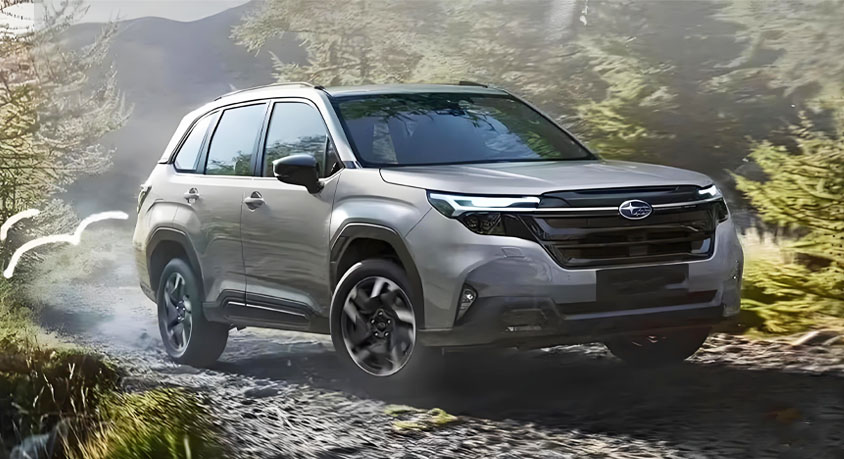
I was standing in a muddy trailhead parking lot in the Cascades last week, looking at a row of crossovers that all looked like they were designed by the same wind tunnel software, when the 2026 Subaru Forester pulled in. My first thought wasn't "wow," it was "wait, is that a Ford Explorer that shrunk in the wash?" For three decades, the Forester was the ultimate "anti-style" statement—a tall, glass-heavy greenhouse on wheels that looked a bit dorky but offered the best visibility in the business. Now, Subaru has given it a "muscular" face-lift with squinty headlights and a bulky grille that screams for attention it never used to need. It’s a classic case of a brand getting insecure about its identity, and as someone who has spent twenty years at Car and Driver defending the dorky pragmatism of Subaru, this pivot toward "toughness" feels like a betrayal of the people who actually buy these things.
The Forester used to be the car for the guy who wears cargo shorts because he actually needs the pockets, not because they’re in fashion. By trying to look more like a rugged off-roader, Subaru has risked sacrificing the one thing that made the Forester king: the greenhouse. The beltline is higher now, and while the pillars are still relatively thin, that "fishbowl" feeling that allowed you to see a toddler or a rogue stump three feet from your bumper is slightly diminished. It’s a compromise made to satisfy focus groups who think every SUV needs to look like it’s ready to conquer the Rubicon, even if it’s just conquering the carpool lane at the local elementary school.
Inside, the story gets even more complicated. Subaru has finally ditched the button-heavy dashboard for a massive 11.6-inch vertical touchscreen. I have a visceral, seething disdain for this trend. Trying to adjust your seat heaters or fan speed while bouncing down a washboard fire road shouldn't feel like playing a high-stakes game of "Operation" on a tablet. I miss the tactile, mechanical click of a physical dial—the kind of control you could operate by muscle memory while keeping your eyes on the road. The steering wheel, at least, still feels like a tool; it has a solid, substantial grip that reminds me of a well-worn baseball bat, far superior to the flimsy, "PS5 controller" feel of the newest Toyotas or Nissans.
When you actually get it moving, the mechanical soul of the Forester remains stubbornly, almost aggressively, consistent. The 2.5-liter Boxer engine doesn't emit a "deep burble" or a sophisticated "scream"; it produces a flat, industrial thrum that sounds like it belongs in a piece of farm equipment. It’s not fast. In fact, merging onto a busy interstate with a trunk full of gear from Home Depot and two barking dogs in the back is a lesson in patience. The CVT (Continuously Variable Transmission) is better than it used to be, but it still has that "rubber band" sensation that makes the engine drone at a constant, agonizing pitch when you bury the throttle.
Compared to the Honda CR-V, the Forester feels like it’s built from a different era of metallurgy. The Honda is smoother, quieter, and feels like a more "finished" product, but the moment the pavement turns to slush or deep mud, the Subaru’s Symmetrical AWD makes the Honda look like a confused amateur. The Toyota RAV4 might have a more modern hybrid powertrain, but its interior feels cramped and dark compared to the airy cabin of the Forester. Subaru’s strength has always been its "honest" mechanicals—you can still crawl under this thing and change your own oil without needing a degree in software engineering or a proprietary dealer scan tool.
Imagine you’re taking the family on a weekend camping trip. You’ve got the roof racks loaded with kayaks and the back stuffed with tents. In a Tesla Model Y, you’d be sweating over your range and the fragile interior plastics. In the Forester, you just drive. The suspension is tuned for the real world—the world of potholes, frost heaves, and gravel—soaking up impacts that would make a Mazda CX-5 wince. It’s a comfort that isn't about luxury; it’s about durability. But I can't help but wonder if the new, heavier-looking bodywork is just adding unnecessary bulk to a chassis that was already perfect in its simplicity.
My biggest gripe with this "redesign" is that Subaru focused on the sheet metal when they should have focused on the heart. We’re still waiting for a powertrain that doesn't feel winded at high altitudes. If they had kept the dorky, upright look and just added thirty horsepower and some physical HVAC buttons, they would have had the perfect vehicle. Instead, we have a car that looks like its competition but still drives like its predecessor.
For the American middle class, the Forester remains a solid, logical choice. It’s a car that respects your wallet and your need for utility. But for the purists, the ones who loved the Forester because it didn't care what you thought of its looks, this new version is a bit of a head-scratcher. It’s still the most capable tool in the shed, but it’s now wearing a costume that doesn't quite fit. If you can get past the screen and the Ford-inspired nose, the "bones" are still there, but you'll find yourself missing the days when Subaru was brave enough to be ugly for the sake of being better. It's a great car, but it’s a little less "Forester" than it used to be.
Disclaimer: Mention of any brand or trademark is for identification only and does not imply partnership or endorsement