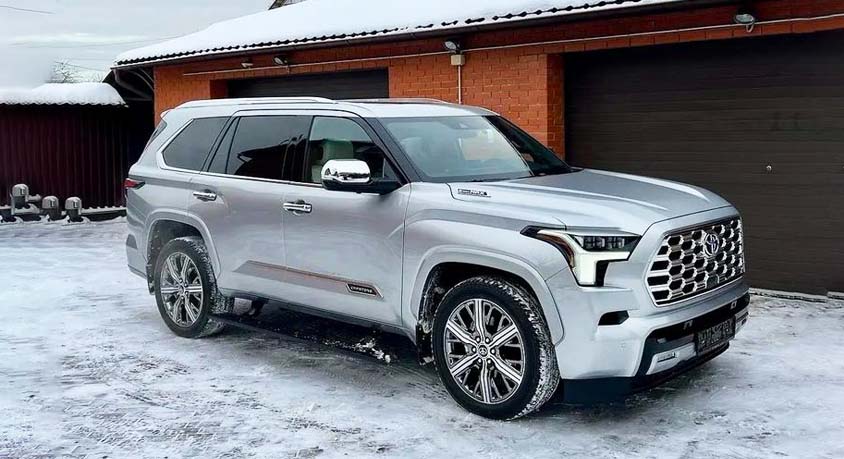
I was standing at a boat ramp in Lake Tahoe last weekend, watching a guy struggle to back a thirty-foot cabin cruiser into the water with a vintage V8 Land Cruiser that sounded like it was coughing up its own valves. That old iron was legendary for its "bulletproof" simplicity, but it was wheezing under the strain of modern expectations. Then, a 2026 Toyota Sequoia TRD Pro rolled up, silent as a ghost until the twin-turbo V6 kicked in with a mechanical snarl. It hauled that same weight like it was pulling a wagon full of feathers. It was a perfect snapshot of the war currently raging in the hearts of Toyota purists: we finally have the massive power we’ve begged for, but we’ve had to trade our beloved, unkillable 5.7-liter V8 for a complex, electrified, twin-turbocharged heart transplant known as the i-FORCE MAX.
Toyota built its entire American empire on the back of the "overbuilt" philosophy—engines that were lazy, thirsty, and heavy, but would essentially outlast the heat death of the universe. With the new Sequoia, they’ve thrown that playbook into the shredder. This hybrid system is an engineering marvel, sandwiching an electric motor between a 3.4-liter V6 and a 10-speed automatic. It churns out a massive 437 horsepower and 583 lb-ft of torque. When you pin the throttle, you don't get the old-school linear climb of an atmospheric engine; you get a relentless, digital surge of torque that pins you into the seat. The exhaust note isn't a "scream" or a high-strung whine; it’s a deep, digitized burble that tries its best to mimic a V8, though the turbo whistle gives away the secret every time you let off the gas.
I have a particular, seething hatred for the way modern manufacturers are obsessed with "sanitizing" the driver's environment with touchscreens the size of a kitchen TV. The Sequoia’s 14-inch display is undeniably impressive, but it’s a smudge-covered distraction that pulls your eyes off the road. Thankfully, Toyota didn't go full-stupid and hide the volume knob or the climate toggles in a sub-menu—I’m looking at you, Tesla and Ford. The steering wheel feels substantial in your hands, more like gripping a heavy-duty sledgehammer than a PS5 controller. It’s a tactile reminder that you are piloting nearly three tons of steel, not playing a video game.
Imagine you’re heading out for a cross-country family vacation, pulling a massive Airstream trailer while the back is loaded with coolers and gear for a week in the wilderness. In the old Sequoia, you’d be watching the fuel gauge drop faster than a lead weight while the engine screamed at 4,000 RPM just to maintain highway speeds on an incline. In this new i-FORCE MAX beast, the electric motor fills in the gaps where the turbos haven't quite spooled up, making the act of towing feel effortless. It’s a night-and-day difference in capability compared to the Chevrolet Tahoe’s aging V8 or the Nissan Armada.
However, complexity is the natural enemy of the DIY mechanic, and this is where the Sequoia starts to lose the purists. When you pop the hood, you aren't greeted by the open, accessible layout of an old-school Tundra. Instead, you’re staring at a high-voltage jungle of orange cables, intercoolers, and plumbing that makes a simple alternator swap look like a mission to Mars. For the guy who spends his Saturday mornings in the garage with a basic socket set and a beer, this truck is a terrifying enigma. You’re trading the peace of mind that comes with mechanical simplicity for the raw performance of a high-tech hybrid.
Comparing the Sequoia to the Ford Expedition is like comparing a tank to a luxury lounge. The Ford’s interior is arguably more comfortable, and its independent rear suspension means the third row doesn't feel like you’re sitting on a park bench with your knees in your chest. The Toyota, by sticking with a solid rear axle to maintain its legendary durability and towing stability, has sacrificed a significant amount of interior packaging. If you’re hauling seven adults to a soccer tournament, the Ford is the better tool. But if you’re hauling that same group over a washboard fire road to reach a remote trailhead, the Ford starts to feel like it’s going to rattle itself apart, while the Toyota feels like it was carved from a single block of granite.
We know the 5.7 V8 could go 400,000 miles. We don't know how a twin-turbo hybrid system will handle a decade of salt, heat, and heavy towing. It’s the most capable, fastest, and most efficient Sequoia ever made, but it’s also the first one that might actually require a computer science degree to maintain after the warranty expires.
If you’re the type of buyer who trades in your rig every four years, buy the Sequoia and don't look back; it will embarrass almost anything else on the road. But if you’re like me—the guy who wants to keep his truck until the wheels fall off and do the work himself—this new hybrid era feels like a bittersweet victory. It’s a better machine in every measurable way, yet I can’t help but miss the honest, thirsty simplicity of the past. Toyota has moved the goalposts, and while the new Sequoia is a touchdown for performance, the purists are still standing on the sidelines, wondering if the soul of the machine got lost in the circuitry.
Disclaimer: Mention of any brand or trademark is for identification only and does not imply partnership or endorsement