


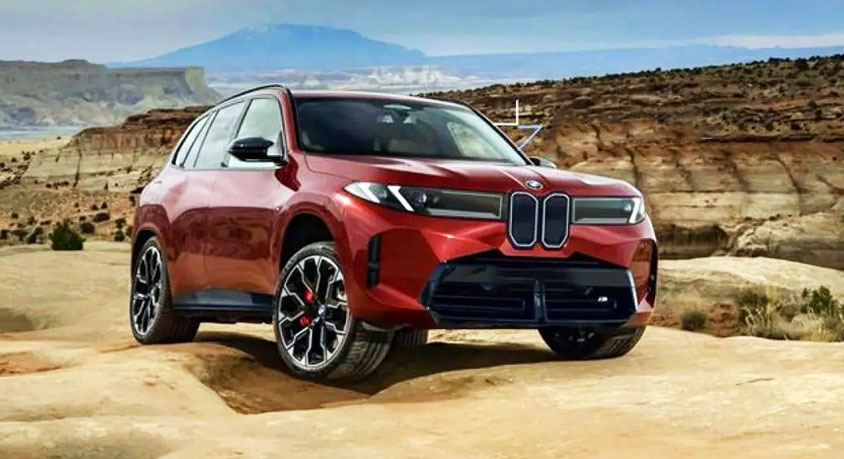
I was carving through a series of rain-slicked sweepers in the North Carolina highlands last week, trying to settle the 2027 BMW X5 into a rhythm, when my passenger asked me to turn down the seat heaters. In any X5 from a decade ago, that was a half-second blind reach to a physical button that clicked with the mechanical certainty of a Swiss watch. Now? I had to take my eyes off the apex, dive into a high-resolution sub-menu on a curved glass slab, and hope the haptic feedback wasn't lagging. It is an absolute, unmitigated disaster of ergonomics. BMW used to build "The Ultimate Driving Machine," but they’ve recently pivoted to building the "Ultimate Distraction Machine," and frankly, it makes me want to drive the car straight into a drainage ditch just to see if the airbags are also hidden behind a touchscreen menu.
The X5 has been the king of the suburban driveway for twenty-five years because it balanced German engineering with a cockpit that actually respected the driver’s intelligence. But this latest "evolution" feels like it was designed by a committee of Silicon Valley interns who have never actually operated a motor vehicle at 70 miles per hour in a thunderstorm. They’ve stripped away the physical buttons for the climate control and replaced them with digital sliders. I have an visceral, seething disdain for this "clean" aesthetic. It’s the same corporate laziness that gives us those flush-mounted, motorized door handles that feel like flimsy plastic toys and freeze shut during a Boston winter. If I’m paying eighty-thousand dollars for a Bavarian bruiser, I want a handle I can grab like a heavy-duty wrench, not a piece of tech that requires a software update to let me into the cabin.
When you stop fighting the screens and actually bury your right foot, the mechanical bones of the X5 remind you why this badge used to mean something. The straight-six under the hood remains a masterpiece of balance and smoothness, emitting a deep, metallic burble at idle that transforms into a sophisticated, mechanical scream as you approach the redline. It doesn't drone like the hybridized four-cylinder in the Volvo XC90, nor does it feel as agricultural as the V6 in an Acura MDX. It’s a pure, unadulterated engine that feels like it has a direct line to your nervous system. The steering wheel grip is substantial, feeling more like you’re holding a solid wooden baseball bat than the hollow, PS5-controller-esque wheels found in the newest Lexuses. There is a weight and a gravity to the way the X5 moves that the competition still hasn't quite replicated.
Imagine you’re heading out for a cross-country family road trip, the back loaded with luggage and a cooler for a week in the mountains. In a Mercedes-Benz GLE, the air suspension will float you over the highway like you’re sitting on a marshmallow, but the moment the road gets twisty, the Benz feels like a barge in a bathtub. The X5 stays flat. It’s composed. It handles the weight with a level of athletic grace that makes you forget you’re piloting a five-thousand-pound SUV. But that joy is constantly interrupted by the iDrive system "helpfully" suggesting a change in cabin fragrance or a new "Experience Mode" that changes the ambient lighting to the color of a neon strip club.
Compared to the Porsche Cayenne, the X5 is still the better daily-driver value, providing nearly identical highway performance for twenty thousand dollars less. But Porsche had the common sense to bring back physical toggles for the most important functions in their latest refresh, admitting that their digital-only experiment was a mistake. BMW, meanwhile, is doubling down on the glass. If you’re a business elite in Singapore or a suburban dad in Greenwich, you’re getting a car that looks like a spaceship and handles like a sports sedan, but you’re also getting a cockpit that treats you like a secondary concern to the software.
The best cars are the ones that disappear around you—the ones where the controls are so intuitive they become an extension of your body. This new X5 does the opposite; it stands between you and the road with a wall of pixels. The hardware is brilliant. The suspension tuning is the best it’s ever been. The ZF eight-speed transmission snaps off shifts with the precision of a professional poker dealer. But all that mechanical excellence is wrapped in a user interface that is nothing short of an electronic trap.
If you’re the type of person who likes to get under the hood on a Saturday morning, you’ll find that the X5 is increasingly a "closed-circuit" machine. You can still change the oil, but the car will scream at you until you plug in a proprietary computer to reset the service light. It’s a trend toward dealer-dependency that I hate with a passion. The X5 used to be a car for people who loved the machine; now, it’s a car for people who love the image of the machine. It’s still the best-driving SUV in its class, but for the first time in twenty-five years, I find myself recommending the competition simply because they’ll let you keep your eyes on the road. BMW has built a phenomenal athlete, then blinded it with a VR headset.
Disclaimer: Mention of any brand or trademark is for identification only and does not imply partnership or endorsement