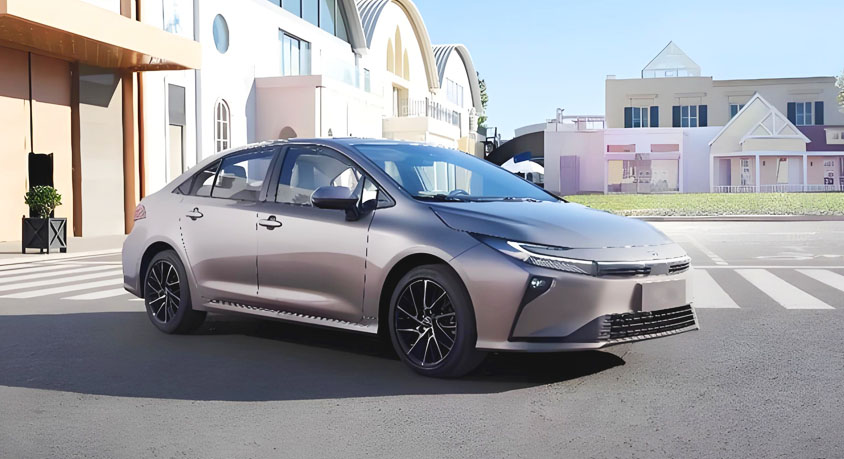
In the realm of economical transportation, decision-making often appears straightforward: prioritize reliability, minimize cost, and opt for the established leader. Toyota Corolla has long dominated this space, a testament to rational choice based on depreciation rates and maintenance records. Yet, a quiet reversal is occurring in dealership lots, where a competitor priced significantly lower—often by $5000—consistently wins over four out of five test drivers after a brief journey behind the wheel. This phenomenon isn't about spreadsheet comparisons; it's a case study in how measured efficiency in personal mobility extends beyond mere numbers into the realm of sensory experience and daily utility.
Consider the dynamic driving character. The Corolla delivers competent, predictable performance, with a focus on fuel efficiency and smooth operation. In contrast, the Mazda3—a frequent contender in this category—transforms the commute into an engaged interaction. Its steering provides direct communication, akin to a precise tool responding to subtle inputs, while the Corolla's setup offers insulated comfort. The chassis refinement in the Mazda3 employs a multi-link rear suspension that absorbs road imperfections with the fluency of a well-rehearsed mechanism, imparting a sense of solidity and control. The Corolla's torsion beam arrangement, though functional, prioritizes cost-effective simplicity, resulting in a ride that is adequate but lacks tactile feedback. Data from independent tests reveal that the Mazda3 achieves higher lateral acceleration figures and shorter braking distances, translating to tangible safety benefits in evasive maneuvers.
Interior execution further illustrates this divide. The Corolla's cabin is designed for durability and ease of cleaning, using materials that withstand wear but often feel utilitarian. The Mazda3 approaches its interior as a driver-centric environment, with soft-touch surfaces, ergonomic seating that supports prolonged driving, and controls arranged for intuitive access. This attention to detail reduces cognitive load during operation, much like an optimized workspace enhances productivity. Standard features in the Mazda3, such as an intuitive infotainment system with rotary controller, minimize distraction compared to the Corolla's more basic touch interface. The perceived quality here isn't frivolous; it directly impacts daily satisfaction and reduces long-term fatigue, a crucial factor for frequent users.
Safety technology, often treated as an optional upgrade, becomes a decisive differentiator when examined closely. The Mazda3 includes its i-Activsense suite as standard across trims, featuring adaptive cruise control, lane-keep assist, and automatic emergency braking with pedestrian detection. The Corolla offers Toyota Safety Sense 2.0 broadly, but certain advanced functions like full-speed adaptive cruise may be restricted to higher trims. This means that for the same or lower price point, the Mazda3 delivers a more comprehensive safety net, acting as a proactive shield rather than a reactive measure. In practical terms, this technology functions like an automated checklist, continuously monitoring risks and intervening to prevent collisions, thereby enhancing overall driving efficiency.
The reversal in buyer preference stems from the experiential gap revealed during test drives. While the Corolla excels in theoretical value, the Mazda3 demonstrates applied performance—where handling precision, cabin ambiance, and seamless safety integrations create an emotional resonance that outweighs initial cost savings. This isn't about irrational choice; it's a recalibration of priorities where long-term usability trumps short-term economy. For the pragmatic individual, the Mazda3 represents a holistic solution: it reduces the friction of daily travel through superior engineering, much like a streamlined process eliminates organizational waste. In the end, the market's shift underscores a principle beyond automotive circles: true efficiency lies in optimizing experience, not just minimizing expense.
Disclaimer: Mention of any brand or trademark is for identification only and does not imply partnership or endorsement