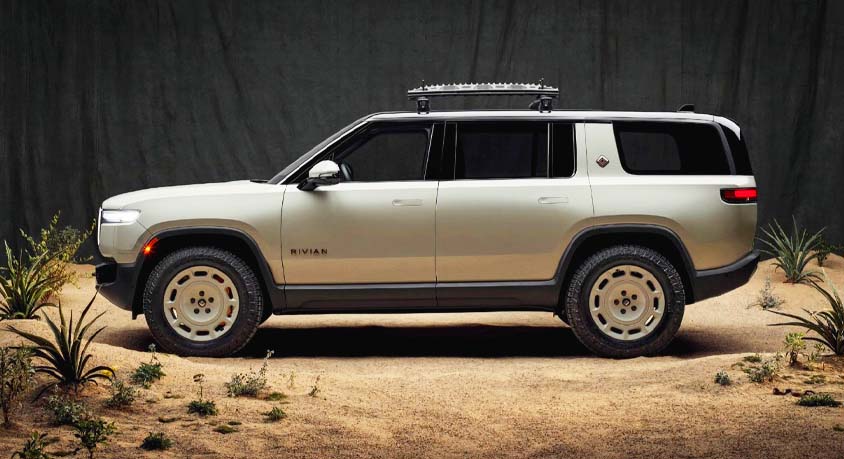
The calculus of a wildfire evacuation order strips automotive choice down to its most brutal fundamentals. It's no longer about horsepower or prestige, but about answers to a series of urgent, practical questions: Can I leave right now? How much of my life can I take with me? Can I think clearly while doing it? In the hills of California, a new variable is being factored into this equation—the electric vehicle. On the surface, an EV's dependence on the grid seems a liability, but a closer examination reveals that its inherent attributes—always being fueled, serene operation, and flexible space—uniquely align with the specific, harrowing physics of emergency egress.
The first advantage is immediate readiness. A gasoline vehicle, if not recently refueled, can be at half a tank or less—a dangerous gamble when evacuation routes become parking lots and gas stations either overwhelmed or without power. A typical EV, like a Ford Mustang Mach-E or Rivian R1S, is "refueled" nightly at home. When an alert sounds at 2 AM, it has a predictable, full charge offering 250-350 miles of range, enough to reach safety in most regional scenarios. There is no detour, no queue, no dependency on a functioning fuel pump. The vehicle transforms from a parked asset into an escape pod with the press of a button, its state of charge a known, reliable quantity in a moment defined by uncertainty.
The cabin environment during flight is the second critical factor. Navigating through smoke-hazed air, navigating traffic jams punctuated by emergency vehicles, requires acute situational awareness and calm decision-making. The near-silent operation of an EV eliminates the added cognitive load of engine roar and vibration, creating a quieter, less stressful bubble. The immediate, linear torque allows for smooth, controlled merging and acceleration without the drama of downshifts or engine noise, helping the driver conserve mental energy. In a high-stress scenario, this serene power delivery is not a luxury; it's a cognitive aid, allowing occupants to process information, reassure family, and listen for crucial radio updates without fighting their own vehicle's cacophony.
This electrical heart also creates a mobile power reservoir. Using vehicle-to-load (V2L) capability, available on vehicles like the R1S or via adapters for the Mach-E, the car can power essential devices when the grid fails. This means keeping phones and radios charged, running a small medical device like a CPAP machine, or powering a lamp in a crowded shelter parking lot. In an extended crisis where a home is without power for days, the EV becomes a lifeline, its battery a substantial power bank that gasoline can only mimic with a noisy, fume-producing generator.
Finally, space is organized for rapid, volumetric packing. The absence of a large engine block allows for a "frunk"—a secondary, lockable, and waterproof cargo space ideal for vital documents, electronics, or a pet carrier. The main cargo area, often a flat-floored design with folding seats, accommodates suitcases, heirloom boxes, and emergency supplies with fewer compromises than a sedan trunk or a high-load-floor SUV. The goal is not neat organization, but maximum, secure cubic footage for irreplaceable items in a frantic loading window.
The EV, therefore, is re-evaluated not as a green statement, but as a rationally optimized crisis tool. It offers the advantage of predictable energy reserves, a calm operating environment, auxiliary power, and pragmatic storage. It does have a critical dependency—a functioning electrical grid before the crisis to achieve that full charge—which underscores the need for personal preparedness. Yet, for those who mitigate that risk, it presents a compelling case. In the face of chaos, it provides a rare commodity: a measure of predictability, silence, and self-contained capability, turning an escape vehicle into a true mobile sanctuary for what, and who, matters most.
Disclaimer: Mention of any brand or trademark is for identification only and does not imply partnership or endorsement