You see it first in their eyes. A Baby Boomer spots the ID. Buzz at a charging station, and their gaze softens, a smile hinting at memories of a different, more analog era. A millennial parent walks past with a stroller, does a double-take, and pulls out their phone—not to check the specs, but to take a picture for Instagram. The Volkswagen ID. Buzz doesn't just enter a space; it triggers an immediate, emotional reaction. This is its superpower and its core strategic gamble. Volkswagen has resurrected one of the most culturally laden silhouettes in automotive history, the T1 Microbus, and fitted it with a state-of-the-art electric skateboard chassis. The critical question isn't whether it's cool—it undeniably is—but whether this potent cocktail of nostalgia and modernity can ferment into mainstream family sales, or if it will remain a delicious but niche beverage for the design-conscious few.
The exterior design is a masterclass in evolutionary referencing. It captures the T1's two-box profile, the short front overhang, and the cheerful, friendly face without becoming a retro pastiche. The large VW badge on the nose even doubles as the charging port door, a clever nod to the past that serves a future function. This design does immense cultural lifting, generating free marketing and instant brand recognition that a blandly styled people-mover could never achieve. It makes the act of driving a minivan—traditionally associated with suburban drudgery—feel like a statement of playful, conscious living. However, this iconic shape imposes aerodynamic and packaging compromises. The near-vertical windshield and slab sides create more wind noise at highway speeds than a sleek SUV, and the stylistically mandated short hood means there is no traditional frunk, a practical sacrifice in the electric segment known for extra storage.
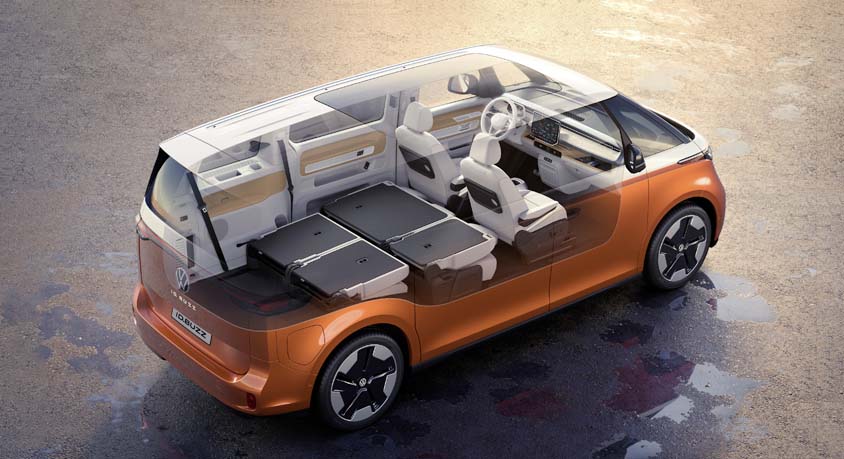
Inside, the theme continues. The cabin is airy and minimalist, with light-colored materials and a sense of openness amplified by the optional two-tone "studio" roof with its small circular windows. The dashboard is clean, dominated by a central touchscreen, and features whimsical details like the Buzz-specific ambient lighting patterns and fabric door pulls. The first two rows offer exceptional space and comfort. The issue arises in the optional third row. To preserve the classic exterior proportions, the rear overhang is short, forcing the third row to sit directly over the rear axle. This results in a cramped, knees-up seating position suitable only for small children on short trips, a significant functional drawback compared to the cavernous, van-like third rows of a Honda Odyssey or even a Kia Carnival. The cargo space behind the third row is similarly minimal, challenging its utility for large family vacations.
On the road, the ID. Buzz reveals its modern Volkswagen Group DNA. The driving position is commanding, the ride quality on its standard adaptive dampers is supple and quiet, absorbing urban imperfections with ease. The rear-wheel-drive-based powertrain provides adequate, smooth acceleration, and the low center of gravity from the floor-mounted battery gives it surprising agility for its tall stature. The estimated 260-mile range for the longer-wheelbase US model is respectable, if not class-leading. Yet, the driving experience is deliberately, perhaps wisely, unengaging. The steering is light and vague, the brake pedal feel is marred by the inconsistent blend of regen and physical braking, and the whole vehicle communicates a sense of being a relaxed, comfortable pod rather than something to be thrown into corners. For its intended family-hauling mission, this is likely correct, but it underscores that the "fun" is purely visual and experiential, not dynamic.
This leads to the ultimate friction point: price and positioning. The ID. Buzz, when well-equipped, easily crests into the high-$60,000 to low-$70,000 range. At this point, it is no longer competing with practical minivans, but with premium three-row electric SUVs like the Rivian R1S and the Kia EV9, which offer more performance, more rugged capability, or more tech for similar money. The purchase decision becomes a profound value judgment. Does the unparalleled style, the emotional resonance, and the unique statement outweigh the practical compromises and the premium cost? For a family that values design, sustainability, and has the disposable income to prioritize character over cubic feet, the answer could be yes. For the average American family seeking maximum utility per dollar, the calculus is far less clear.
The ID. Buzz is therefore not a vehicle; it's a litmus test. It tests the market's willingness to pay a substantial "nostalgia premium" and to accept certain practical trade-offs for unparalleled style and a warm, fuzzy feeling. Volkswagen is betting that in the homogenizing world of electric crossovers, a strong, positive emotional connection is a rare and valuable commodity. It may not become the sales juggernaut a Sienna is, but it doesn't need to. Its success will be measured by its ability to attract a profitable, loyal segment of buyers who see their vehicle not just as an appliance, but as an extension of their identity—a rolling piece of optimistic design that happens to carry the soccer team. In doing so, it might just prove that in the cold, hard math of EVs, there's still room for a little warm, groovy magic.
Disclaimer: Mention of any brand or trademark is for identification only and does not imply partnership or endorsement