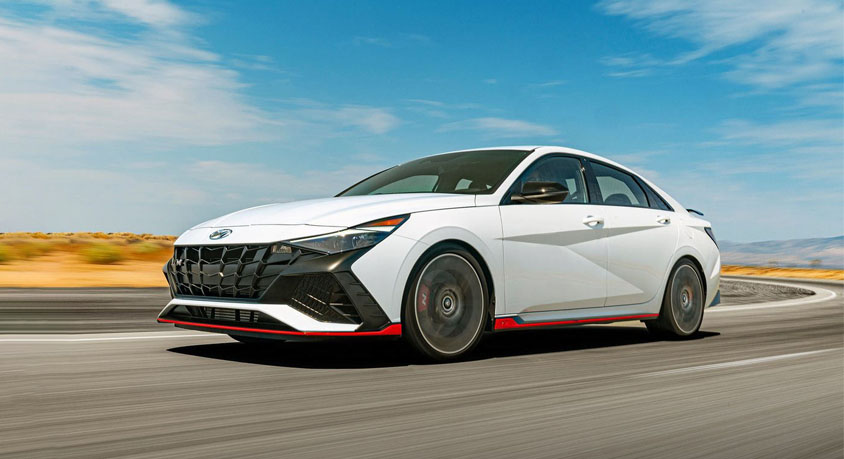
For decades, the performance car covenant was simple: you paid a premium for engineering that communicated directly through the steering wheel and pedals, a raw, unfiltered dialogue between machine and driver. This purist ethos, championed by icons like the Honda Civic Type R, often came with a steep financial and practical entry fee, gatekeeping high-G excitement for a dedicated few. Sitting in the driver's seat of the Hyundai Elantra N, however, one is confronted with a different proposition—a central blue "N" button that feels less like an ignition and more like an invitation to a configurable physics engine, a suite of electronic levers that place a startling degree of track-grade tuning at your thumb-tips for nearly half the price.
Press that button, and the dashboard transforms into a mission control center, offering individual authority over the engine's throttle map, the electronic limited-slip differential's aggressiveness, the stability control's intervention level, the exhaust note's intensity, and the suspension's damping force. This isn't a choice between "Comfort" and "Sport" presets; it's akin to having a detailed graphic equalizer for dynamics, where you can dial in a soft suspension for a broken road while keeping the steering weight heavy and the differential locked for crisp corner exits. The 2.0-liter turbocharged four-cylinder, producing 276 horsepower in its standard form, responds with immediacy or lethargy based on your throttle setting, teaching you about engine mapping through direct, visceral feedback.
The crown jewel of this electronic arsenal is the N Grin Shift, or NGS, function. Activated via a steering wheel paddle, it acts as a tactical overboost, remapping the turbocharger's parameters to inject an additional 10 horsepower for 20-second intervals and sharpening gear shifts to their most aggressive setting. It’s not merely a power bump; it's a carefully orchestrated burst of hyper-competence, like a chess player being granted a temporary time bonus to execute a complex combination. This system democratizes a sensation reserved for supercars with intricate boost strategies, allowing a driver to deploy it for overtaking on a backroad or shaving seconds off a lap time, all without mechanical complexity.
Contrast this with the Civic Type R's more analog approach, which relies on exceptional chassis geometry, a brilliant manual transmission, and direct hydraulic steering to achieve its brilliance. The Honda demands skill to extract its peak, a rewarding but demanding partner. The Elantra N, conversely, uses its electronic brain to flatten the learning curve, its customizable differential and stability systems acting as a dynamic safety net that can be gradually lowered as driver confidence grows. Its eight-speed wet dual-clutch transmission, when in its most ferocious mode, delivers shifts with a violence that borders on the theatrical, yet it can seamlessly slip back into civility for a commute.
The engineering philosophy extends beyond software to hardware calibrated for this electronic interplay. The integrated drive axle, which bundles the driveshaft and half-shafts to reduce unsprung weight, works in concert with the adjustable suspension to maintain composure over crests and compressions. The larger brakes aren't just for show; they are heat-managed components designed for repeated hard use, a necessity when the car’s systems encourage such accessible, repeatable performance. You find yourself exploring limits you might otherwise avoid in a more intimidating, expensive machine, simply because the tools to manage and understand those limits are built into the interface.
In essence, the Elantra N represents a paradigm shift. It challenges the notion that pure mechanical feedback is the sole path to driving enlightenment, proposing instead that customizable electronic mediation can amplify enjoyment and accessibility. It asks a profound question: is the ultimate driver's car one that is solely demanding of its operator, or one that intelligently extends its capabilities to meet the operator where they are? By placing a motorsport-derived tuning suite into a compact sedan at $33,000, Hyundai hasn't just built a fast car; it has engineered a compelling argument for a new kind of performance democracy.
Disclaimer: Mention of any brand or trademark is for identification only and does not imply partnership or endorsement